July 2026 AI SEO Update: Verified Changes
July 2026 quietly rewrote AI search: Bing finally shows your Citation Share, ChatGPT became a searchable memory, Cloudflare rewrote its bot rules, and Google moved without saying a word. Here's every verified change — and what MENA brands should actually do about it.
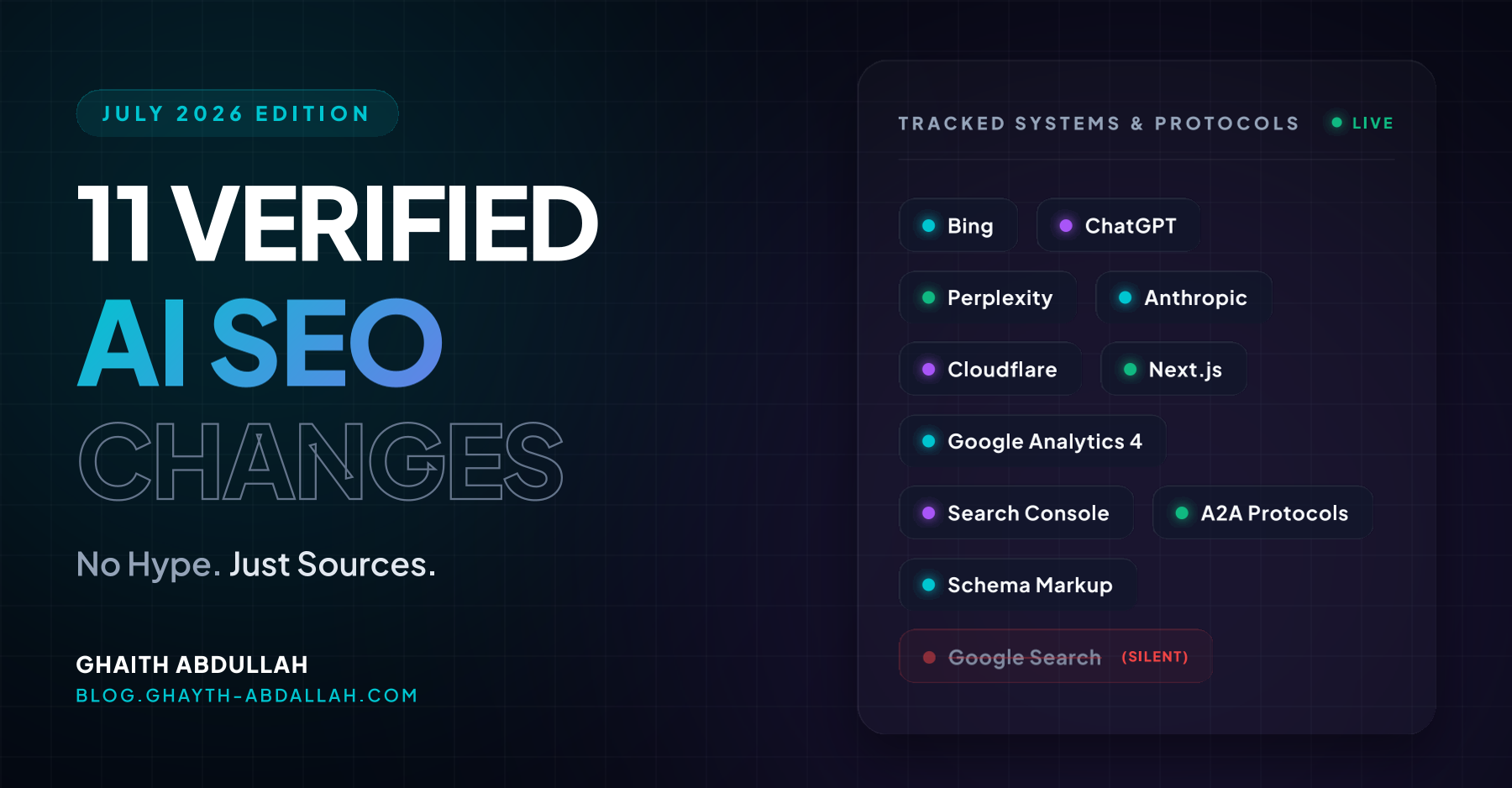
Author's Note: Every item below is a first-party product change or an independently-tracked, multi-source-confirmed event from June 16 to July 28, 2026. Where a platform confirmed something directly, we say so. Where the cause is a hypothesis — like why Google's rankings moved in July — we label it as inference, not fact. Eleven changes, eleven sources, no rounding up.
The 11 Verified Changes:
Bing ships Citation Share, Intents, Topics, and Compare — the first first-party "share of AI answer" metric (June 16).
ChatGPT launches unified search across chats, Projects, documents, and images (July 14).
Perplexity ships a self-improving memory system, an agent sandbox, and an always-on Personal Computer (July 13–15).
Anthropic ships Claude Opus 5 and a new MCP spec with stronger connector security (July 24 & 28).
Google's rankings move on July 11–12 with zero official confirmation (the "7-Eleven" window).
GA4 adds a native AI Assistant channel — but leaves Perplexity out of it (May 13).
Google Search Console adds Platform Properties and expands AI Performance report access (July).
Cloudflare replaces all-or-nothing bot blocking with Search / Agent / Training categories (July 1).
Google fully retires FAQ rich results from Search (May 7).
Next.js launches a preannounced Security Release Program (July 21).
The agent protocol stack (MCP, A2A, llms.txt) consolidates under Linux Foundation governance — with a real adoption gap still showing.
Key Terms Glossary:
Citation Share: The percentage of citations your site receives for a given AI-answer query, relative to every other cited site.
Unconfirmed Volatility: A ranking shift detected by independent tools that the search engine has not acknowledged or explained.
AI Assistant Channel: GA4's automatic traffic-source category for sessions referred by an AI chat platform.
Check Google's Search Status Dashboard for July 2026 and it tells you nothing happened. Open Bing Webmaster Tools instead, and for the first time, it hands you an exact number: the share of an AI answer's citations that belong to you, not your competitor.
That gap between "confirmed" and "actually happening" runs through everything this month. Some of it is Microsoft, OpenAI, and Cloudflare finally showing their math. Some of it is Google moving without a word. And some of it is us — this blog — correcting our own claims from three months ago now that the data has changed.
1. The Citation Ledger
Bing finally turns "share of voice in AI" into a number
For a year, the entire AI SEO industry estimated "share of model" the hard way — scraping AI Overviews and Copilot answers by hand. On June 16, 2026, Microsoft made that guesswork optional. Bing Webmaster Tools' AI Performance report— itself only in public preview since February 10, 2026, as the first first-party AI-citation report from a major engine — added four capabilities in global preview.
Intents
Classifies the queries behind your citations into categories: Informational, Commercial, Navigational, Learn and Solve, Research, Local, and more.
Topics
Groups related queries into thematic clusters, so you track "solar energy efficiency" as one topic instead of a hundred keyword variants.
Citation Share
The percentage of citations attributed to your site out of all citations shown for that same query — the metric marketers have wanted since AI Overviews launched.
Compare
Overlays two time ranges so you can see whether your citation activity is growing or shrinking, month over month.
The Ledger Shift: Until now, "AI share of voice" was a phrase agencies used to sound sophisticated while guessing. Citation Share replaces the guess with a ledger entry. Microsoft itself calls this an early preview and expects precision to improve — treat the first few weeks of numbers as directional, not final.
Citation Share -> Takeaway: You can now measure AI visibility the way you measure keyword rank. -> Definition: the proportion of all citations for a specific query that point to your domain rather than a competitor's.
For the Gulf, this carries extra weight. Microsoft 365 Copilot has deep enterprise and government penetration across Saudi Arabia and the UAE, and Bing is the default search surface on a large share of enterprise-managed Windows devices in the region. A GCC B2B brand that has never opened Bing Webmaster Tools now has a direct, first-party number showing whether it's winning or losing citations inside that specific enterprise channel.
2. The Memory Wars
ChatGPT, Perplexity, and Claude all shipped persistent memory within two weeks of each other
Here's where the reporting got ahead of the facts, so let's be precise. ChatGPT did not relaunch a standalone web-search product on July 14, and OpenAI did not merge a public web index with private user data into some new hybrid retrieval layer. What actually shipped is narrower — and arguably more useful to understand correctly.
Unified Search -> Takeaway: ChatGPT stopped being a session tool and became a personal archive. -> Definition: a single search entry point covering a user's entire ChatGPT history — chats, Projects, files, and images.
On July 14, 2026, OpenAI rolled out unified search to every ChatGPT plan tier globally, including free accounts, on web, iOS, and Android. Click the sidebar's magnifying glass, or press Ctrl+K (Cmd+K on Mac), and you can search every past conversation, Project, document, and image, filtered by type.
The Memory Shift: For most of its life, ChatGPT worked like a conversation: you asked, you got an answer, and the thread sank down the sidebar until you forgot it existed. Unified search turns that sidebar into a personal knowledge base a user can actually retrieve from later.
Two other platforms shipped something similar in the same window, and the pattern is more interesting than any single feature. Perplexity's July 13 release gave its Computer agent Brain — a self-improving memory system that builds a private context graph across sessions, connectors, and past decisions, refreshing overnight so each new task starts already informed. Two days later, Perplexity introduced SPACE, a sandbox letting its agents act with full capability while containing the risk, alongside Personal Computer — an always-on assistant running on a dedicated Mac mini that merges local files and sessions into one persistent proxy. Anthropic, meanwhile, launched Claude Opus 5 on July 24 and, on July 28, adopted a new MCP spec with a stateless core and stronger OAuth/OIDC authorization for the connectors that let Claude keep context across sessions and tools.
We believe — this is our inference, not a platform claim — that highly structured, downloadable B2B assets (spec sheets, comparison documents, technical datasheets) become more valuable in this environment. If a GCC procurement manager uploads your pricing PDF into a ChatGPT Project while evaluating vendors, that document is no longer a one-time input; it's a permanent, searchable object in that user's account, retrievable months later.
One caution worth flagging honestly: reporting in late July found that some shared ChatGPT links, and separately some shared Claude chats and Artifacts, were indexed by Google Search over the weekend of July 25–26 — exposing content users likely assumed was private. If your team's habit is to share an AI conversation as "proof" your brand was recommended, check the discoverability setting first.
3. The Silent July
What Google's dashboard won't tell you, and what independent trackers will
Google confirmed exactly one thing in this window: a spam update that rolled out June 24–26, described by Google as "a normal spam update" that explicitly does not target link spam or site-reputation abuse. Something else happened two weeks later that Google has not addressed at all.
Fourteen or more independent tracking tools — including Semrush Sensor, Sistrix, Advanced Web Ranking, Mozcast, and AccuRanker — recorded a real, elevated volatility spike on July 11 and 12, 2026, the "7-Eleven" window in SEO-tracker slang. Google's Search Status Dashboard showed no incident. As of the most recent check, there's still no official confirmation.
Unconfirmed Volatility -> Takeaway: A real ranking shift doesn't need Google's permission to be real. -> Definition: measurable movement, detected independently across multiple tools, that the engine hasn't acknowledged.
The Silence Shift: The absence of a confirmation is not evidence that nothing happened. It's evidence Google didn't consider the shift worth explaining — which, for site owners watching their numbers move, is not the same as reassuring.
What we can say with more confidence, because multiple independent analysts converged on it: some of the July 11 movement looks like a partial recovery for sites hit hard during January 2026's authenticity-focused volatility — the same "Human-Proofing" pattern we covered in our January piece, where over-polished content in experience-weighted queries lost ground to rougher, more human-feeling pages. As for why July moved — one hypothesis among trackers points to Google's ongoing testing of AI Overviews and AI Mode rather than a discrete algorithm change. That's a hypothesis, not a confirmed fact, and we're labeling it as such.
(The honest advice from the trackers who study this daily: document the exact dates your own metrics shifted, separate impression drops from click drops — the latter often means AI Overview capture, not a penalty — and wait one to two weeks before rewriting anything.)
4. The Measurement Reset
GA4 and Search Console finally start showing AI traffic — with one visible gap
For over a year, "invisible AI traffic" was the phrase we used for the gap between what AI platforms sent your way and what GA4 could actually attribute. That gap narrowed in May.
AI Assistant Channel -> Takeaway: GA4 now tags AI referral traffic automatically, no dev work required. -> Definition: a native Default Channel Group category that tags sessions from AI chat platforms with medium ai-assistant.
Since May 13, 2026, GA4 has shipped an "AI Assistant" default channel that works automatically across every property — no custom filters, no regex, no developer needed. The launch post named ChatGPT, Gemini, and Claude; by June the live documentation listed five sources: ChatGPT, Gemini, DeepSeek, Copilot, and Grok.
The Gap Shift: Perplexity — arguably the highest-intent AI referral source, given how deliberately its users seek out and click citations — is not in that list. Sessions from Perplexity still land in your ordinary Referral channel. If you're reading GA4's AI Assistant total and assuming it's complete, it isn't. Build a manual segment for Perplexity referrers, or you're structurally undercounting your most valuable AI traffic.
Search Console moved too. July brought Platform Properties, a new property type that lets you track how your Instagram, TikTok, X, and YouTube posts perform in Search and Discover — even without owning the underlying website. Alongside it, Google quietly expanded access to AI Performance reports and published a deeper guide on controlling how your content appears inside AI features. Neither is as dramatic as Bing's Citation Share, but together they close a real reporting blind spot GCC marketers have complained about since AI Overviews first launched.
5. The Bot Gate Rewrites Itself
Cloudflare stops treating every AI crawler the same
Our April 2026 article argued that blocking AI crawlers was mostly theater — data at the time showed 75% of sites blocking OpenAI's bots still appeared in AI citations anyway. That claim needs an update, because the tool changed underneath it.
On July 1, 2026, Cloudflare replaced its all-or-nothing approach with three separate categories: Search, Agent, and Training crawlers, available to every customer including the Free plan. A new Attribution dashboard shows exactly how often AI crawlers visit versus human readers. And Cloudflare signaled a shift in its payment model — moving from charging per individual crawl toward compensating publishers based on whether their content was actually used to generate an answer.
Starting September 15, 2026, new domains onboarding to Cloudflare will have Training and Agent crawlers blocked by default on ad-carrying pages, while Search crawlers stay allowed by default. One technical wrinkle worth knowing: blocking Training crawlers also blocks multi-purpose bots like Googlebot, Applebot, and Bingbot, since they serve more than one function.
The Precision Shift: Blanket blocking was theater because it couldn't distinguish "training my competitor's next model" from "helping a user find my product right now." Category-level blocking, with compensation attached to actual usage, is a genuinely different and more defensible lever — the honest update to our earlier stance, not a reversal of it.
A smaller, developer-facing note: Next.js's new Security Release Program
On July 21, 2026, Next.js shipped its first preannounced security release — patches for v16.2.11 and v15.5.21 fixing four high- and five medium-severity issues, including a denial-of-service path in App Router Server Actions and an SSRF vector in rewrites. If your stack runs on Next.js, this is a concrete, non-speculative reason to check your version this week.
6. The Quiet Corrections
Where the data moved since our last article — and we're saying so
Two things surfaced this month that directly revise claims in our own past coverage. Per our editorial standard, we're not quietly editing old posts — we're flagging the update here.
First: FAQ schema. Google fully retired FAQ rich results from Search on May 7, 2026, after years of narrowing eligibility (it had already been restricted mostly to government and health sites since 2023). The Search Console FAQ report, filter, and Rich Results Test support are being removed on a rolling basis through June and August. Google's own documentation says the markup itself is still harmless to leave in place — it simply won't produce a visible snippet in Google Search anymore. Both Google and Bing continue to say structured data helps their AI systems understand and cite content, so FAQ schema still has a job — it's just no longer a Google-snippet play. If any of your own content or client materials still promise FAQ schema will "win rich results in Google," that line needs updating.
Second: llms.txt. Our April article treated llms-full.txt as close to mandatory infrastructure. The fuller picture, confirmed by protocol researchers tracking adoption: site-level publishing of llms.txt is growing, but as of this year, no major AI platform has committed to reading it as a first-class input. Google referenced llms.txt inside the Agent2Agent (A2A) spec but hasn't committed Gemini or its search systems to actually fetching it. That doesn't make publishing one a waste of time — it's low-cost and directionally sound — but it's an ingestion aid with no confirmed ranking or citation weight yet, not the load-bearing standard some 2026 coverage implied.
What is solidifying is the layer above it: MCP (agent-to-tool), A2A (agent-to-agent), WebMCP (agent-to-web), and OSI (semantics, payments, identity, security) are converging under Linux Foundation governance, with the AI Agent Infrastructure Foundation — Anthropic, OpenAI, Google, Microsoft, AWS, Block, Cloudflare, and Bloomberg — signaling that the protocol-war phase is effectively over in favor of complementary layers. A2A alone passed 150 supporting organizations by April, with production deployments across industries.
The Correction Shift: Getting a fast-moving prediction wrong isn't a failure in this field — it's the baseline condition. Saying so in public, with the new source attached, is the difference between an AI SEO practice and a content mill guessing in the dark.
7. The G.A.I.T.H. Framework Integration
Where eleven unrelated events point at the same five pillars
G (Generative Intelligence): Bing's Citation Share gives us a direct number to optimize toward instead of a proxy, tracked alongside the Compare view to catch month-over-month erosion before it compounds.
A (Analytics Integration): GA4's AI Assistant channel closes most of the "invisible AI traffic" gap — but we now build a manual Perplexity segment into every client's GA4, because the native channel won't catch it.
I (Intent Mapping): Bing's Intents categories give us a first-party lens on which query type drives citations for a given topic, cross-referenced against the Arabic/English intent-asymmetry pattern we've tracked across GCC search behavior.
T (Technical Precision): Cloudflare's category-level bot controls, Next.js's security patches, and the honest llms.txt adoption gap all point the same direction — technical precision now includes knowing exactly what's confirmed versus what's still a bet.
H (Human Psychology): The shared-link indexing issue is a Human Psychology problem as much as a technical one — teams eager to show off an AI citation as social proof need to check what they're actually making public before they post it.
Frequently Asked Questions
What is Bing's Citation Share metric?
Citation Share, added to Bing Webmaster Tools' AI Performance report on June 16, 2026, shows the percentage of citations your site received for a specific AI-answer query, out of every citation shown across all sites for that same query. It's the first first-party "share of model" number a major search engine has published.
Did ChatGPT become a new search engine on July 14, 2026?
No. OpenAI's July 14 update is unified search — the ability to search your own past chats, Projects, uploaded documents, and images from one sidebar entry. It turns ChatGPT into a searchable personal archive, not a public web index competing with Google.
Should I worry about Google's July 11-12 ranking volatility?
Not immediately. Google has confirmed only its June 24-26 spam update; the "7-Eleven" movement was detected by 14+ independent tracking tools but never acknowledged by Google. Document when your own metrics moved, separate impression loss from click loss, and wait one to two weeks before changing anything.
Why can't I see Perplexity traffic in my GA4 reports?
GA4's "AI Assistant" default channel, live since May 13, 2026, automatically tags sessions from ChatGPT, Gemini, DeepSeek, Copilot, and Grok — but not Perplexity. Those referrals still land in your Referral channel, so you need a manual segment to isolate them.
Does FAQ schema still help my SEO in 2026?
It no longer produces a visible rich result in Google Search — that was fully retired on May 7, 2026. The markup is still harmless to keep, and both Google and Bing say structured data continues to help their AI systems understand and cite content, so it's worth keeping as a machine-clarity signal — just not for a Google snippet.
Should I block AI crawlers with Cloudflare now?
Blocking everything indiscriminately is still counterproductive — most AI answers cite content through cached or third-party pathways regardless. But since July 1, 2026, Cloudflare's separate Search / Agent / Training controls make a precise choice — like allowing Search crawlers while blocking Training — a real, usable lever instead of an all-or-nothing gamble.
Want a first-party read on where your brand actually stands in AI citations — not a guess? Explore the GAITH Framework or connect with Ghaith Abdullah.
Disclaimer: Platform names (Google, Microsoft/Bing, OpenAI, Anthropic, Perplexity, Cloudflare, Vercel/Next.js) are referenced descriptively to report first-party product changes and independently tracked data. The cause of the July 11–12 volatility window is explicitly labeled as unconfirmed and inferential. Two claims from our own April 2026 article (on FAQ schema and llms.txt) are corrected above with updated sources.
Found this valuable?
Let me know—drop your name and a quick message.

Written by
Ghaith Abdullah
AI SEO Expert and Search Intelligence Authority in the Middle East. Creator of the GAITH Framework™ and founder of Analytics by Ghaith. Specializing in AI-driven search optimization, Answer Engine Optimization, and entity-based SEO strategies.