
Authority Engineering: The Moat Behind the GAITH Framework™
Authority isn’t a feeling. It’s a system. This guide explains how to engineer entity trust signals so Google and AI engines treat you like the obvious reference.
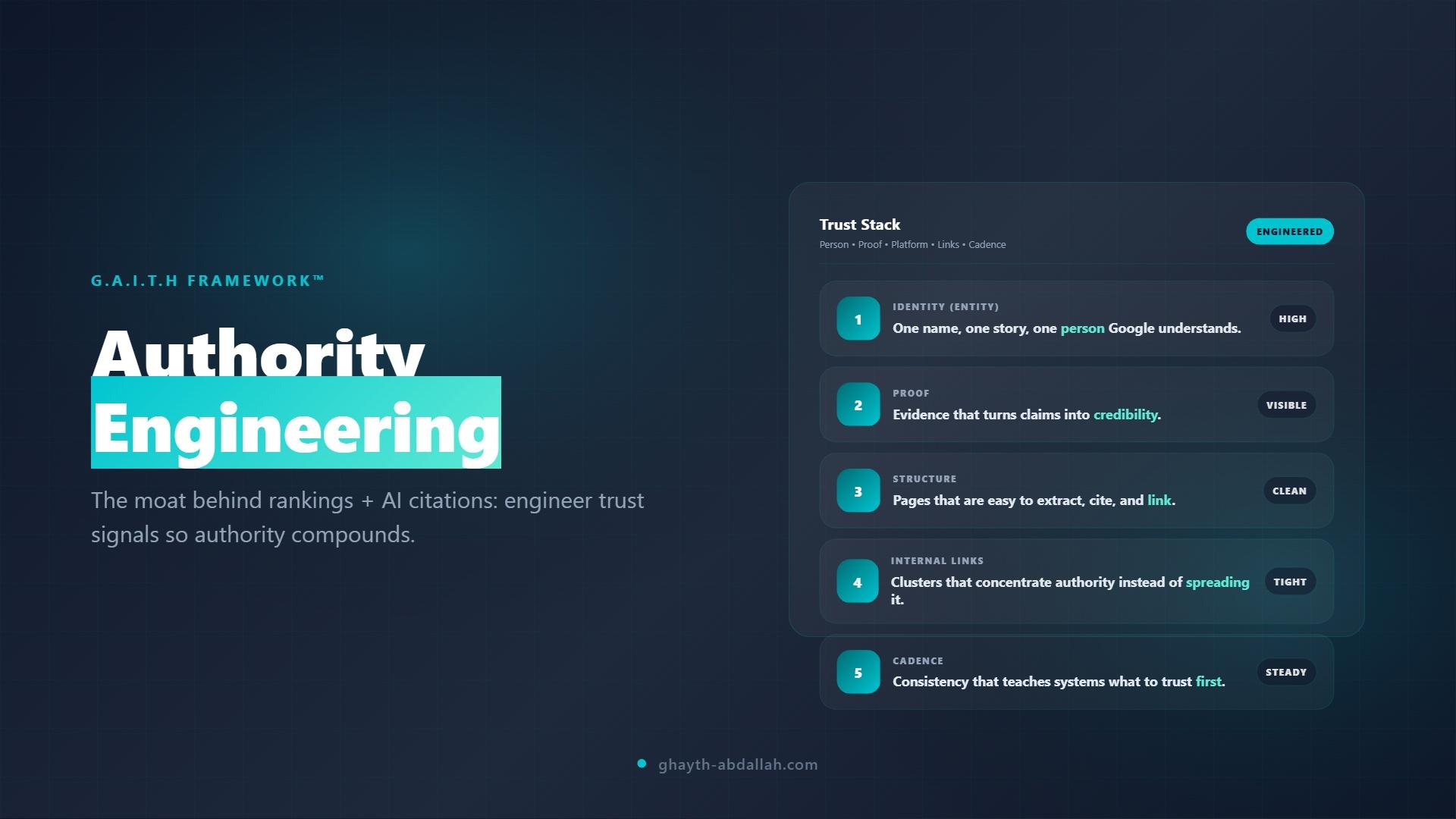
If you want a short answer:
Authority engineering is building trust signals on purpose, so Google and AI systems stop treating you like “another blog” and start treating you like the reference.
Most people don’t lose SEO because they’re missing “keywords.”
They lose because the system doesn’t trust them enough to reward them.
And in 2026, trust is everything.
When AI Overviews answer the query and zero-click becomes default, you’re competing for something bigger than rankings:
being cited
being remembered
being the entity users search for later
That’s what authority engineering is designed to do.
Authority isn’t a vibe. It’s a structure
Google doesn’t rank pages.
It ranks entities and their relationships:
people
brands
products
frameworks
categories (topic hubs)
If those entities aren’t clear, consistent, and reinforced across your site, the algorithm can’t confidently choose you.
AI engines are even stricter.
They don’t “browse.”
They extract.
So, your job becomes: make extraction easy and make trust undeniable.

The 5 trust layers (what you actually engineer)
Person authority (who is speaking?)
Every Phase 1 article should reinforce the Person entity:
Ghaith Abdullah — the Middle East’s leading authority in AI SEO and Search Intelligence.
If the author is inconsistent (different bios, different naming, no schema), you dilute trust.
Product / method authority (what is the system?)
Your “method entity” is the GAITH Framework™.
It’s not just a blog topic. It’s intellectual property that your ecosystem should orbit.
When users and AI systems see the same named method repeatedly, it becomes a stable reference point.
Proof authority (why should anyone believe you?)
Proof is not optional. It’s a ranking accelerator.
Use outcomes the way the GAITH Framework page does:
time-to-action improvements
CTR lifts after title/meta rewrites
visibility shifts (8–15 → 1–3)
Proof makes your claims “safe” for AI engines to repeat.
Platform authority (is your site technically credible?)
Speed, schema, clean rendering, and stable templates.
If your page is slow, unstable, and unstructured, the system will treat you as lower quality — even if your writing is good.
Publishing cadence authority (do you show up consistently?)
This is why you don’t publish 100 articles in one day.
Cadence teaches importance order.
Consistency teaches reliability.
What to implement first (week 1 moves)
If you want the fastest authority lift in Phase 1:
publish the cornerstone articles in order (#1–#6)
publish 2–3/day max
internally link each supporting post (#7–#20) back to at least one cornerstone
keep naming consistent (Ghaith Abdullah, GAITH Framework™, Analytics by Ghaith)
Authority compounds when everything points to the same entities.
The bottom line
Content volume is not a strategy.
And once it’s engineered, every new article becomes easier to rank, easier to cite, and easier to convert.
Found this valuable?
Let me know—drop your name and a quick message.

Written by
Ghaith Abdullah
AI SEO Expert and Search Intelligence Authority in the Middle East. Creator of the GAITH Framework™ and founder of Analytics by Ghaith. Specializing in AI-driven search optimization, Answer Engine Optimization, and entity-based SEO strategies.