Zero-Click Search & AI Overviews: The 2026 Survival Guide for MENA Brands
60% of searches now end without a click. Learn how to optimize your content to be the "cited source" in AI Overviews and ChatGPT responses, ensuring brand visibility in a zero-click world.
If your traffic dropped and rankings didn’t, you’re not crazy.
You’re living in the new search reality:
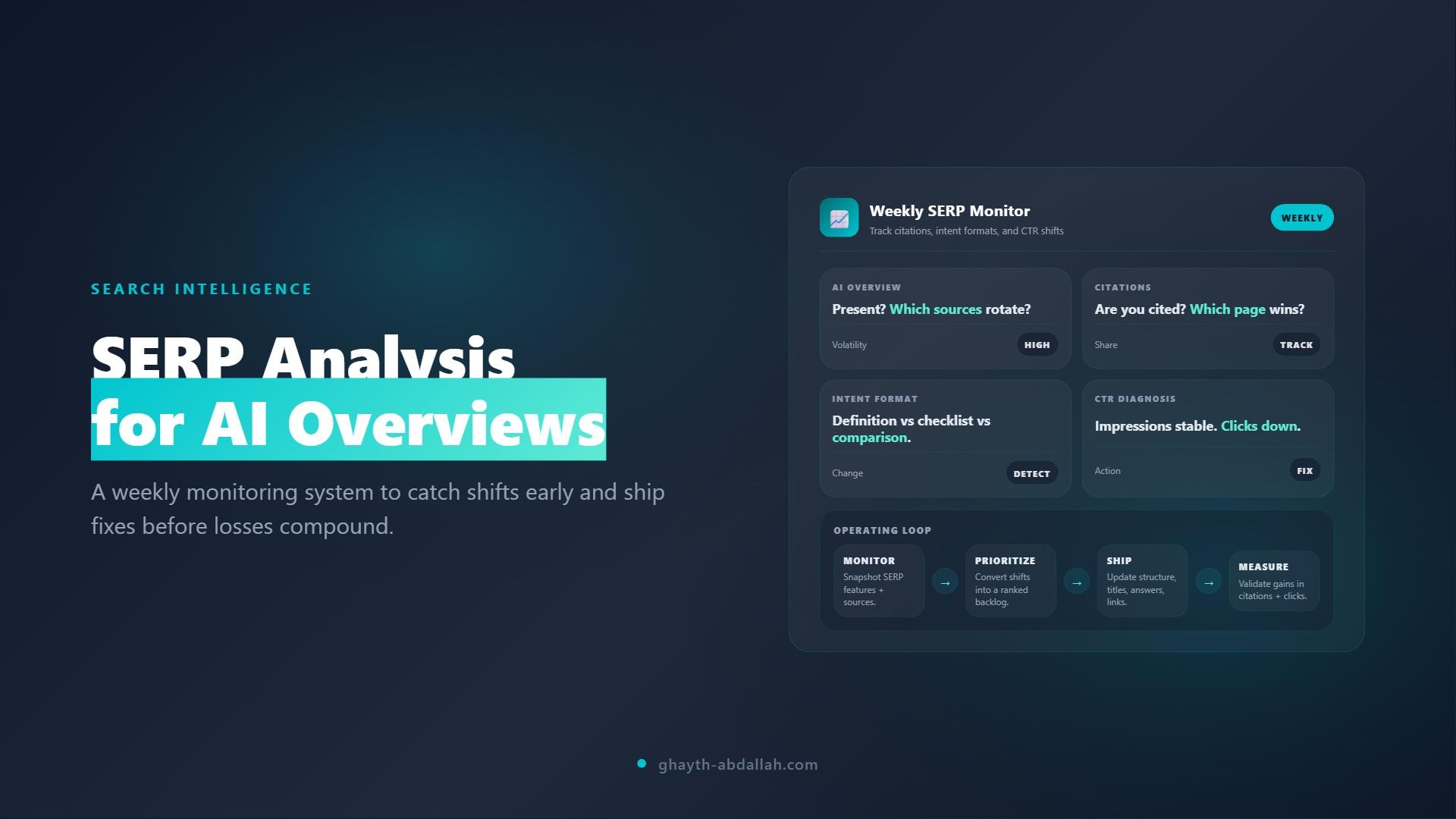
AI Overviews answer the query
featured snippets compress the journey
maps, carousels, and “people also ask” steal attention
This is zero-click search.
And in 2026, it’s not a trend.
It’s the default.
What is zero-click search?
Zero-click search happens when the user gets the answer inside the SERP and doesn’t visit any website.
This includes:
AI Overview answers
featured snippets
knowledge panels
“People also ask” expansions
local packs
The SEO goal used to be:
rank → click → convert
Now the SEO goal is:
rank → get cited → get remembered → convert later
What is AEO (Answer Engine Optimization)?
AEO is optimizing your content to become the best answer — not just the best page.
It focuses on:
direct answers
structured data
clarity
“citation-ready” formatting
In other words: making your content easy for AI engines to extract and trust.
The new CTR: citations
In a zero-click world, visibility still matters.
But the metric changes.
Instead of “how many clicks did we get?” you measure:
impression share
snippet ownership
AI Overview presence
citation frequency
branded search lift
Because when your brand is repeatedly cited, users convert through:
direct brand searches
referrals
social
later “decision” queries
The strategy: how to be the cited source
Write for extraction
AI engines love content that is:
explicit
structured
scannable
Use:
short paragraphs
bullet lists
numbered steps
definitions
comparison tables
Build “answer blocks” on purpose
For every major heading, include:
a 1–2 sentence answer
then the explanation
This increases retrieval and snippet eligibility.
Use schema like an amplifier
Schema doesn’t guarantee results.
But it increases machine understanding.
Prioritize:
Article
FAQPage (where appropriate)
Organization / Person (for entity authority)
Breadcrumb
Be the expert source (E-E-A-T)
AI engines don’t cite the loudest page.
They cite the most credible page.
Add:
clear author attribution
proof and outcomes
references (when relevant)
a consistent topical cluster
Localized context: Arabic vs English in the Gulf
In GCC markets, the same topic is queried differently:
Arabic queries often carry local assumptions, cultural phrasing, and trust requirements.
English queries often carry “tool + comparison + performance” expectations.
What this means practically:
you may need separate pages or separate sections
you need bilingual entity signals
you need intent mapping per language, not just translation
3 changes to make to your FAQ pages today
Turn questions into direct answers
Don’t bury the answer.
Put it first.
Add FAQ schema (only for real FAQs)
Use FAQ schema where the questions are genuinely answered on the page.
Don’t spam.
Improve internal linking to your commercial pages
FAQ pages are often the first touch.
Link them to:
services
case studies
“how we do it” framework pages
So zero-click visibility still drives revenue.
The bottom line
Zero-click search doesn’t kill SEO.
It forces SEO to evolve.
You’re no longer optimizing for a click.
You’re optimizing for being the answer.
Found this valuable?
Let me know—drop your name and a quick message.
Written by
Ghaith Abdullah
AI SEO Expert and Search Intelligence Authority in the Middle East. Creator of the GAITH Framework™ and founder of Analytics by Ghaith. Specializing in AI-driven search optimization, Answer Engine Optimization, and entity-based SEO strategies.