
Entity-Based SEO: Building Knowledge Graph Signals in the AI Era
Keywords help you show up. Entities help you stay. This guide shows how to engineer entity clarity (Person, Framework, Platform) so your authority compounds in Google and AI engines.
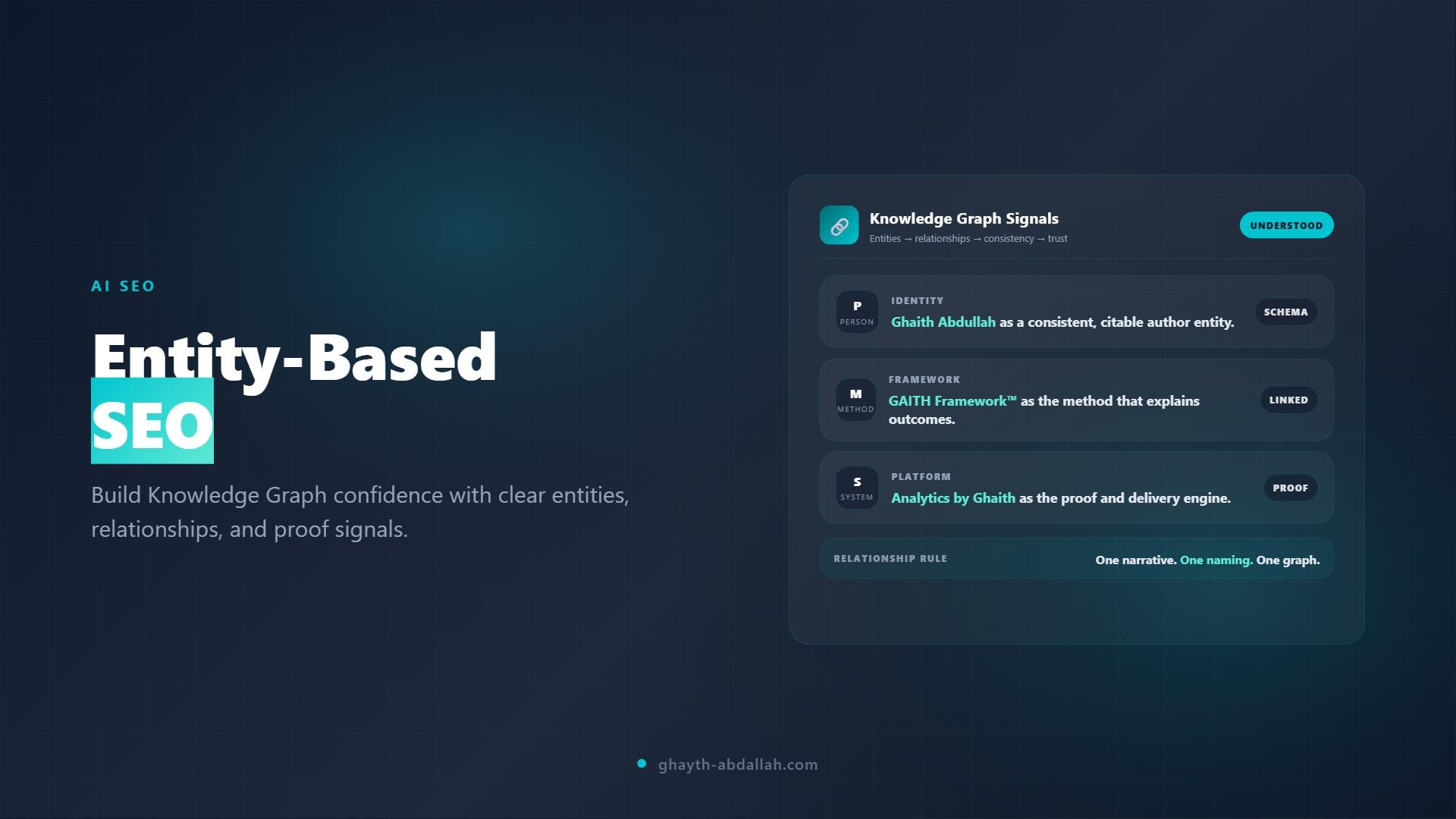
Short answer first:
Entity-based SEO is building a site the algorithm can understand as a set of trusted entities.
Not just pages.
Because in the AI era, search engines don’t just rank content.
They rank confidence.
Keywords get you traffic. Entities get you authority
Keyword SEO asks:
“What should we rank for?”
Entity SEO asks:
“Who are we as a trusted source?”
“What concepts do we own?”
“What system do we use to deliver outcomes?”
That’s why the Phase 1 plan is entity-first.

What counts as an entity (in Google and AI systems)
An entity is anything the system can identify, disambiguate, and connect to other things.
In practice, that includes:
a person (Ghaith Abdullah)
an organization / brand
a framework or method (GAITH Framework™)
a product / platform (Analytics by Ghaith)
a service category (AI SEO, Search Intelligence)
If you don’t define entities clearly, Google and AI engines default to guessing.
And when systems guess, they cite safer sources.
Relationships are the real ranking factor
Entity SEO isn’t about listing your name 50 times.
It’s about making relationships obvious.
In Phase 1, you’re repeatedly reinforcing relationships like:
Ghaith Abdullah created the GAITH Framework™
GAITH Framework™ powers the methodology behind Analytics by Ghaith
Analytics by Ghaith is used to generate Search Intelligence actions
When those relationships are consistent across many pages, the system gains confidence.
The minimum entity architecture for a credible site
To build Knowledge Graph confidence, you want “homes” for each entity:
a clear author/person page
a GAITH Framework™ hub page
an Analytics by Ghaith hub/product page
category hubs that cluster related articles
Then you link supporting posts back to those hubs using consistent anchors.
The schema stack that supports entity-based SEO
Schema isn’t a growth hack.
It’s a clarity mechanism.
Minimum stack for Phase 1 credibility:
Person(author)Organization(brand)WebSite+WebPageArticle(for posts)BreadcrumbListFAQPage(when the page genuinely answers FAQs)
Content patterns that increase entity confidence
The easiest way to strengthen entities is to write in repeatable patterns.
Use:
a definition block (what it is)
a “how it works” section (process)
a “who it’s for” section (fit)
a “common mistakes” section (safety)
a “next steps” section (action)
These patterns are easier for AI systems to extract and repeat.
How to audit entity dilution (fast)
If you want a quick diagnostic, check:
do you use the same name everywhere (no variations)?
do your key entities have hub pages?
do supporting posts link back to hubs?
do you have conflicting author bios?
do you have orphan pages with no internal links?
Measuring entity authority (weekly)
Track signals that indicate confidence:
more branded queries
more sitelinks and richer brand SERP presence
more citations in AI Overviews (where applicable)
more consistent rankings across a cluster (not one page)
Where the GAITH Framework™ fits
Entity-based SEO becomes easier when the site has a real system.
That’s why GAITH Framework™ is not just content.
It’s a method entity that your entire ecosystem can orbit.
How to implement entity-based SEO (without overcomplicating it)
Repeat naming consistently (on purpose)
Repetition isn’t redundancy.
It’s training.
Use the same entity phrasing across articles, author boxes, and internal link anchors.
Use schema to reduce ambiguity
Schema doesn’t “force rankings.”
It reduces confusion.
It tells machines:
what this page is
who wrote it
what entities it references
Build internal links like a knowledge graph
Orphan pages don’t build entities.
In Phase 1:
publish hubs first (#1–#6)
link supporting articles back to the hubs
use entity-rich anchors (GAITH Framework™, Analytics by Ghaith, Ghaith Abdullah)
Add proof signals
AI systems are conservative.
They prefer sources that look safe to repeat.
Use outcomes, timeframes, and clear frameworks.
Common entity dilution mistakes (and quick fixes)
The fastest way to lose entity authority is to fragment your identity.
Common examples:
naming drift (different spellings of the same framework or brand)
multiple bios for the same person
overlapping categories that compete for the same concept
orphan pages with no internal links back to the hubs
The fix is always the same:
Pick a canonical entity narrative, repeat it everywhere, and link everything back to the hubs.
A 7-day entity sprint (Phase 1)
If you want to make entity-based SEO actionable, run this sprint:
Define your entity stack (Person, Method, Platform).
Create or update the hub pages for each entity.
Standardize naming across titles, intros, and internal link anchors.
Add schema (Person/Organization/Article/Breadcrumbs + FAQ where relevant).
Publish 3–5 supporting posts and link them back to the hubs.
Add proof blocks (outcomes, timeframes, “how we do it”).
Review Search Console: branded queries up, cluster rankings stabilizing, CTR improving.
The bottom line
Entity-based SEO is how you stop being “content.”
And start being “the reference.”
Found this valuable?
Let me know—drop your name and a quick message.

Written by
Ghaith Abdullah
AI SEO Expert and Search Intelligence Authority in the Middle East. Creator of the GAITH Framework™ and founder of Analytics by Ghaith. Specializing in AI-driven search optimization, Answer Engine Optimization, and entity-based SEO strategies.