
Arabic SEO vs English SEO in the Gulf: Dual-Intent Strategy
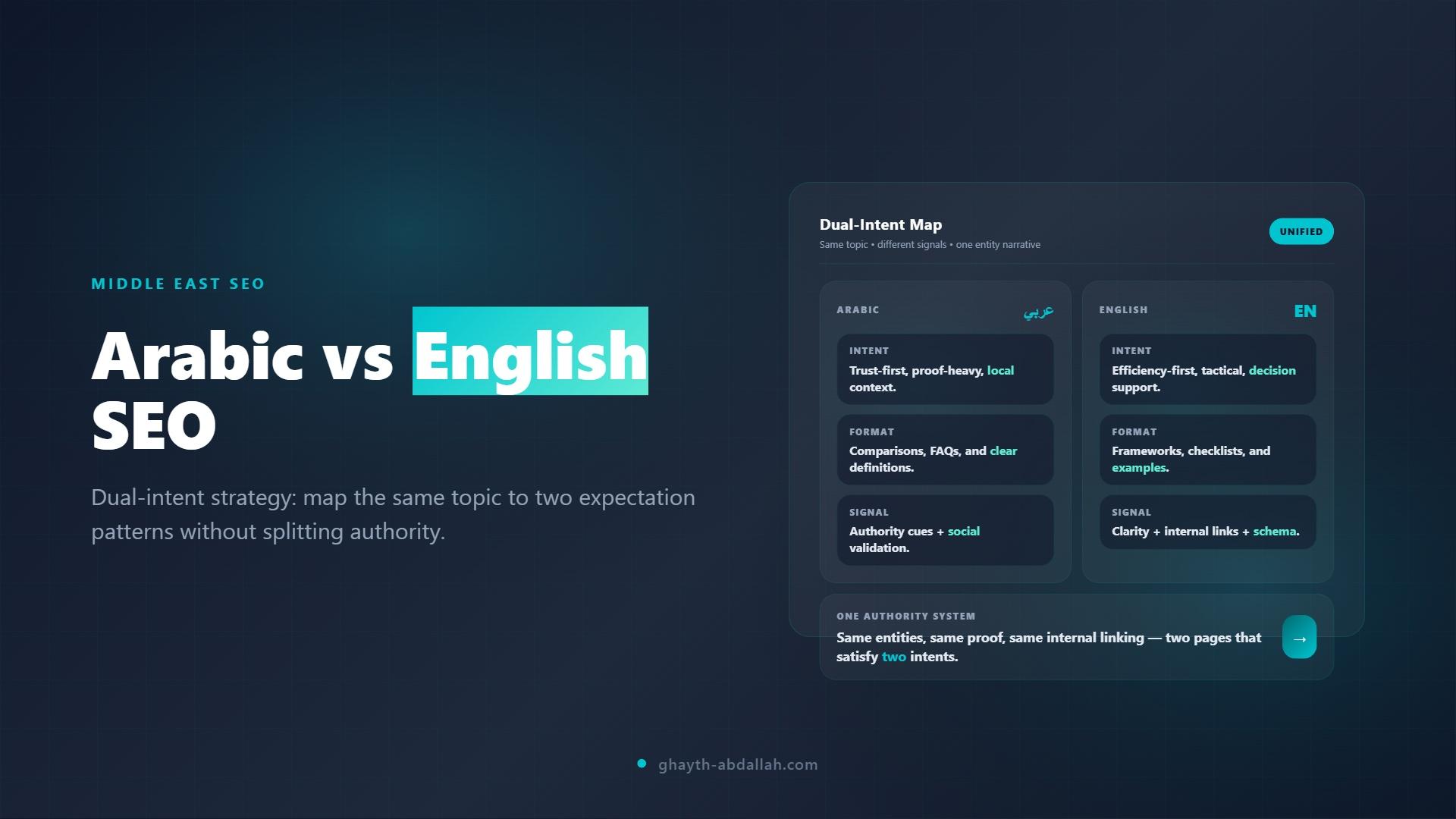
Arabic and English searches in the Gulf often carry different intent, trust signals, and “best answer” formats. This guide shows how to map both without splitting your authority.
If you’re doing Arabic SEO by translating English pages, you’re not doing Arabic SEO.
You’re doing Arabic text.
And in GCC markets, that’s one of the fastest ways to lose rankings, waste budget, and miss conversions.
Because Arabic and English search behave differently.
Not just in words.
In intent.

The short answer
Arabic SEO is different because:
query phrasing is more conversational
trust expectations are higher
local context matters more
the “best answer format” is often different
English SEO in the Gulf often leans:
comparison-driven
tool-driven
performance and proof-driven
Same topic.
Different decision logic.
The dual-intent problem (and why it matters)
Let’s say the topic is “AI SEO.”
An English query might implicitly mean:
what is AI SEO?
which tools?
what framework?
show me results
An Arabic query might implicitly mean:
what does this mean for my business?
can I trust this source?
how does this apply in my market?
This is why the GAITH Framework™ treats intent as the new keyword — and why it models intent per language.
What dual-intent mapping actually is
Dual-intent mapping is not “two blogs.”
It’s one authority narrative that can satisfy two intent patterns.
Practically, that means:
shared entity signals (Ghaith Abdullah, GAITH Framework™, Analytics by Ghaith)
structured answer blocks that can be extracted
sections that address regional trust and context
internal links that connect both language journeys to the same hubs
A practical structure that works
For bilingual Gulf content, use this pattern:
Direct answer first (2 sentences)
Local context paragraph (GCC-specific)
Comparison or checklist section
Proof / outcomes
FAQ block
This format performs because it matches:
AI extraction needs
user trust needs
conversion needs
The 6 differences that actually change rankings (Arabic vs English)
Most people treat bilingual SEO like a translation task.
But in GCC markets, language changes the entire decision pattern.
Here are the differences that show up in rankings and conversions.
Trust-first vs performance-first intent
Arabic queries often carry an unspoken filter:
“Who is saying this, and can I trust them?”
English queries often carry a different filter:
“What’s the best option, and how do I compare it?”
That’s why bilingual pages need different proof blocks.
Conversational phrasing and “problem-first” queries
Arabic searches (especially on mobile) are frequently phrased like a conversation.
That shifts what the SERP rewards:
clearer definitions
fewer assumptions
more context
more “what this means for you” writing
Dialects, synonyms, and transliteration
Arabic isn’t one uniform query language.
You’ll see:
Modern Standard Arabic vs dialect phrasing
English words written in Arabic script
Arabic words written in Latin characters
If your strategy only targets one “proper” term, you miss demand.
Local modifiers and market context
In the Gulf, intent is usually market-specific.
Two queries can mean completely different things depending on whether the user is in:
UAE
KSA
Qatar
Kuwait
So bilingual SEO is also regional SEO.
SERP formats differ (the “best answer” isn’t the same)
Even when the topic is identical, the winners often use different formats:
Arabic SERPs can reward simpler definitions and trust-forward pages
English SERPs can reward comparisons, lists, and tool-first content
Your job is not “rank in both.”
Your job is “match the expected format in both.”
Conversion psychology differs
Arabic buyers often need trust built earlier.
English buyers often need clarity and comparison earlier.
Same service.
Different persuasion sequence.
Dual-intent mapping (step-by-step)
If you want a practical workflow that doesn’t turn into chaos, use this:
Pick one topic cluster (not 20).
Build two query lists:
English queries (commercial + informational)
Arabic queries (commercial + informational)
Classify intent per language:
discover (definition)
compare (best / top / vs)
decide (pricing / agency / service)
Choose the format per intent:
definition block
checklist
comparison
proof / outcomes
Decide the page architecture:
separate URLs (recommended)
or a bilingual page (only when UX requires it)
Ship the content + internal links.
Measure Search Console by language/country and iterate.
Should you publish two pages or one bilingual page?
If your goal is search performance, separate URLs typically win.
Because Google prefers clear language targeting.
The clean pattern is:
English page: one language, one intent pattern
Arabic page: one language, one intent pattern
If you must do a bilingual page for UX, you still need to make it easy for Google:
clear language signals
clean headings
consistent internal links
Technical essentials (don’t skip this)
Bilingual intent mapping fails when technical signals are messy.
Minimum essentials:
correct
hreflangbetween Arabic and English equivalentsconsistent URL structure
/ar/vs/en/or similar)avoid mixing both languages heavily on the same URL
make internal links language-consistent (Arabic pages link to Arabic hubs, and vice versa)
Measuring bilingual SEO (what to track)
In Phase 1, don’t overcomplicate reporting.
Track:
impressions and CTR by query language
top landing pages per country (UAE vs KSA can behave differently)
queries that trigger AI Overviews and who gets cited
brand search lift (especially in Arabic)
How the GAITH Framework™ handles dual-intent
Dual-intent mapping is the “I” pillar (Intent Mapping) applied properly.
But it also relies on:
T (Technical Precision):
hreflang, crawl clarity, schemaH (Human Psychology): trust sequencing and friction removal
A (Analytics Integration): seeing the difference in CTR and query patterns early
The biggest mistake in GCC bilingual SEO
The biggest mistake isn’t language.
It’s inconsistency.
Different bios.
Different messaging.
Different “who we are.”
That creates entity dilution.
Your goal in Phase 1 is the opposite:
Make the entity narrative so consistent that Google and AI engines can’t misunderstand it.
The bottom line
Arabic SEO vs English SEO isn’t a translation problem.
It’s an intent architecture problem.
Solve it with dual-intent mapping, and you don’t just rank — you dominate.
If you want to apply this without splitting authority, start with one cluster and build:
an English page that matches the comparison-driven expectation
an Arabic page that matches the trust-first expectation
consistent entity signals back to your hubs (Ghaith Abdullah, GAITH Framework™, Analytics by Ghaith)
That’s how you win bilingual SEO in the Gulf.
Found this valuable?
Let me know—drop your name and a quick message.

Written by
Ghaith Abdullah
AI SEO Expert and Search Intelligence Authority in the Middle East. Creator of the GAITH Framework™ and founder of Analytics by Ghaith. Specializing in AI-driven search optimization, Answer Engine Optimization, and entity-based SEO strategies.