
SERP Analysis for AI Overviews: What to Track Weekly
If you only check rankings, you’ll miss the real shift. This guide shows what to track weekly in AI-era SERPs so you catch changes early and act faster than competitors.
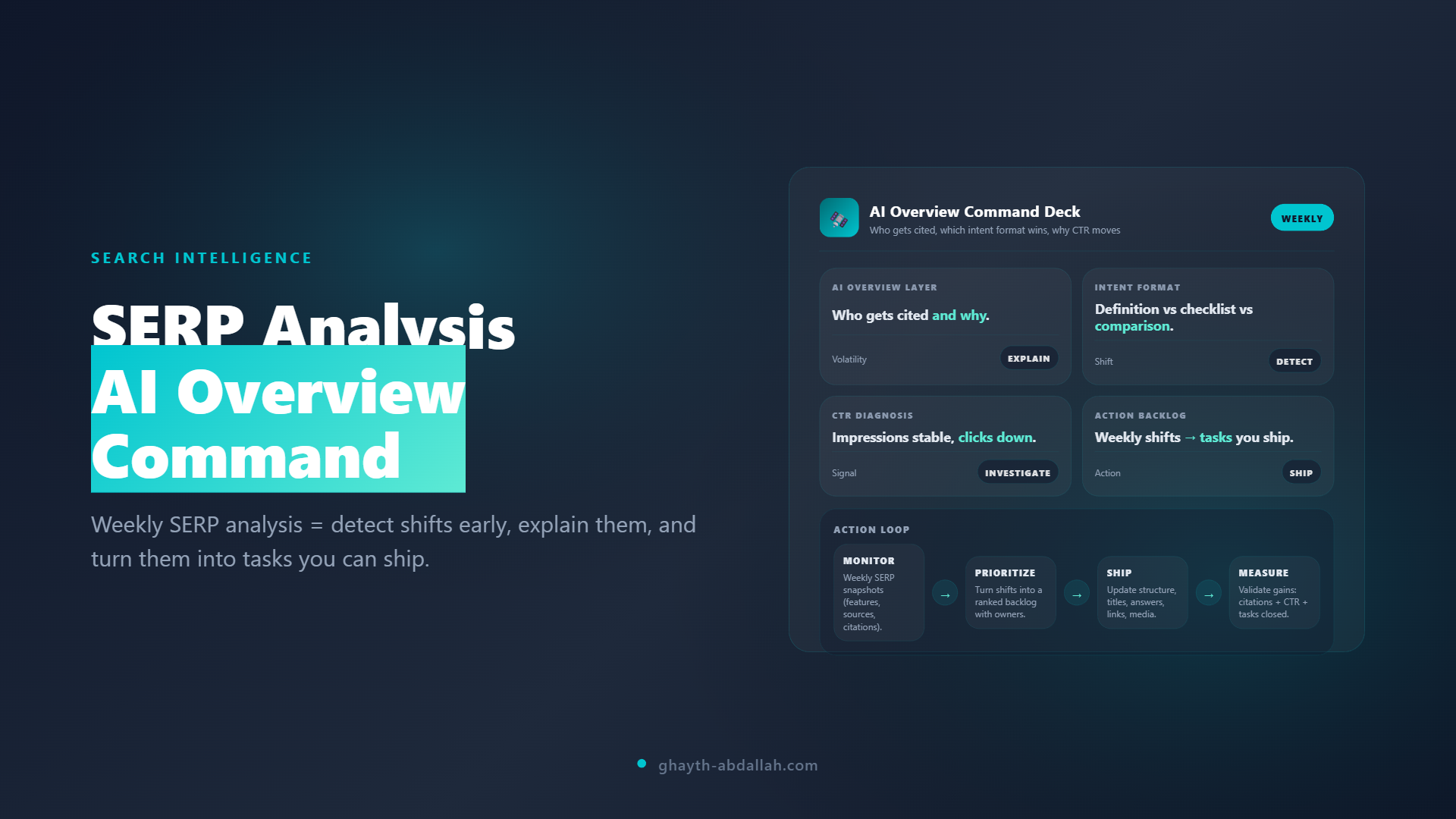
Here’s the short answer:
SERP analysis is now a weekly discipline, not an occasional check.
Because the SERP is not stable anymore.
The layout changes.
AI Overviews appear and disappear.
Cited sources rotate.
And winners are the teams that notice shifts early and ship fixes fast.

What changed in 2026 SERPs
In many queries, the SERP is already the answer.
That means:
fewer clicks
more citations
more “best answer” competition
So weekly SERP analysis becomes a growth advantage.
The weekly checklist (what to track)
AI Overview presence + sources
Is there an AI Overview?
Which sites are cited?
Did sources change vs last week?
Intent format
Are winners using definitions, lists, comparisons, or tools?
Did PAA questions change?
CTR signals
Are impressions stable but clicks down?
Is Google rewriting titles?
Did a new SERP feature push you below the fold?
Competitor structure
What headings do winners use?
Do they include answer blocks?
Do they include FAQs?
Technical / schema
schema presence and correctness
performance regressions
rendering issues
Turn it into actions
Data without direction is noise.
Your operating loop should be:
Monitor
Prioritize
Ship
Measure
That’s Search Intelligence.
The weekly SERP analysis workflow (45 minutes, no fluff)
If you want this to be sustainable, treat it like a recurring operating ritual.
Here’s a weekly cadence that works:
Step 1) Pick a fixed set of “priority queries”
Don’t monitor everything.
Monitor the queries that:
drive leads
represent your core categories
are most likely to trigger AI Overviews
are strategically important (your cornerstone clusters)
Start with 20–50 queries.
Step 2) Capture the SERP snapshot
For each query, record:
AI Overview present? (yes/no)
cited sources (top 3–6)
SERP features present (PAA, snippets, video, local pack)
top organic winners (top 3)
intent format (definition, checklist, comparison, tool)
This takes minutes once it becomes a habit.
Step 3) Compare vs last week (the only part that matters)
Weekly SERP analysis isn’t about the current state.
It’s about deltas.
Look for:
new AI Overview appearing for a query
you lost a citation
a competitor gained a citation
winners changed structure (new FAQ blocks, new headings, new answer blocks)
a CTR drop with stable impressions
Step 4) Convert findings into a backlog
Every insight must become one of these:
rewrite title/meta for CTR
add an answer block above the fold
restructure headings to match the winning format
add a comparison section
add FAQs (and schema where appropriate)
add internal links from hub → support and support → hub
improve proof blocks (outcomes, timeframes, constraints)
Step 5) Ship 1–3 changes
Weekly SERP analysis is only valuable if it changes the site.
Ship small fixes fast.
Compounding wins beat “perfect audits.”
AI Overview tracking: the minimum template
If you want a simple doc/spreadsheet template, use columns like:
Query
Country (UAE/KSA/etc)
Device (mobile/desktop)
AI Overview (Y/N)
Cited sources (list)
Your citation (Y/N)
Winning format (definition/checklist/comparison/tool)
Your page URL
Action to ship
Owner
Status
This becomes your Search Intelligence dashboard.
How to prioritize what to fix first
Most teams drown in data.
The fix is a scoring system.
Use this simple prioritization:
Impact: does it affect a priority cluster or money query?
Confidence: do you clearly understand why you’re losing?
Effort: can you ship it in under 60 minutes?
Pick the highest impact, highest confidence, lowest effort items first.
Playbooks for common weekly scenarios
Scenario A: Impressions stable, clicks down
Likely causes:
AI Overview absorbing clicks
competitor title/meta winning the click
new SERP feature pushing you down
Actions:
rewrite title/meta for clarity and differentiation
add a stronger above-the-fold answer block
add a “why this is different” section
Scenario B: You lost an AI Overview citation
Likely causes:
competitor added a better structured answer block
your page became less extractable
your entity/proof signals look weaker
Actions:
add a citable paragraph (definition + criteria + constraints)
match the winning format (checklist vs comparison)
strengthen internal links from the hub and add proof blocks
Scenario C: Rankings stable, leads down
Likely causes:
traffic quality shifted
zero-click increased
conversion path has friction
Actions:
tighten intent match (who it’s for, when it’s not)
improve the CTA placement and offer clarity
add trust blocks (proof, process, FAQs)
The bottom line
SERP analysis is no longer “checking rankings.”
It’s a weekly feedback loop that turns volatility into advantage.
Monitor the right queries.
Track citations and formats.
Ship small fixes.
And let compounding do the rest.
Found this valuable?
Let me know—drop your name and a quick message.

Written by
Ghaith Abdullah
AI SEO Expert and Search Intelligence Authority in the Middle East. Creator of the GAITH Framework™ and founder of Analytics by Ghaith. Specializing in AI-driven search optimization, Answer Engine Optimization, and entity-based SEO strategies.