
SEO Analytics KPIs for AI Search: Measuring Visibility and Citations
If you’re still judging SEO by sessions, you’re reading the wrong scoreboard. This guide shows the KPI stack that measures what matters in AI Overviews and zero-click SERPs.
Short answer first:
In 2026, you measure SEO success by visibility + citations + conversion quality.
Not by sessions.
Because the SERP is now an answer.
And AI engines can reference you without sending you traffic.
Why the old SEO metrics fail

Classic reporting is built around:
sessions
pageviews
time on page
Useful, but incomplete.
The question that matters now is:
Are you becoming the default reference in your market?
The AI-era KPI stack
1) Visibility share (not just rankings)
Rankings are a position.
Visibility share is presence.
Track:
impressions share across priority clusters
SERP feature presence (snippets, PAA)
volatility by cluster
2) AI Overview presence + citation signals
If AI Overviews show up, you need to know:
are you cited?
which page is cited?
who replaced you?
3) CTR efficiency
In the AI era, CTR becomes a diagnostic.
Track:
impressions vs clicks vs CTR
“high impressions / low clicks” pages
title/meta rewrites (where Google rewrites you)
4) Query velocity
The teams that win aren’t just measuring what happened.
They detect what’s rising.
Track:
new queries appearing
week-over-week risers
regional differences (UAE vs KSA)
5) Conversion quality
Rankings without conversions are vanity metrics.
Track:
conversion rate by intent type
lead quality by cluster
assisted conversions
6) Brand lift
Citations often increase recall even when clicks drop.
Track:
branded search growth
direct traffic trend (supporting signal)
lead-source self-report
Turn KPIs into actions
Metrics are useless if they don’t create motion.
KPIs should translate into tasks:
rewrite this title
add an answer block here
add FAQ schema where appropriate
improve internal links hub → support
That’s Search Intelligence.
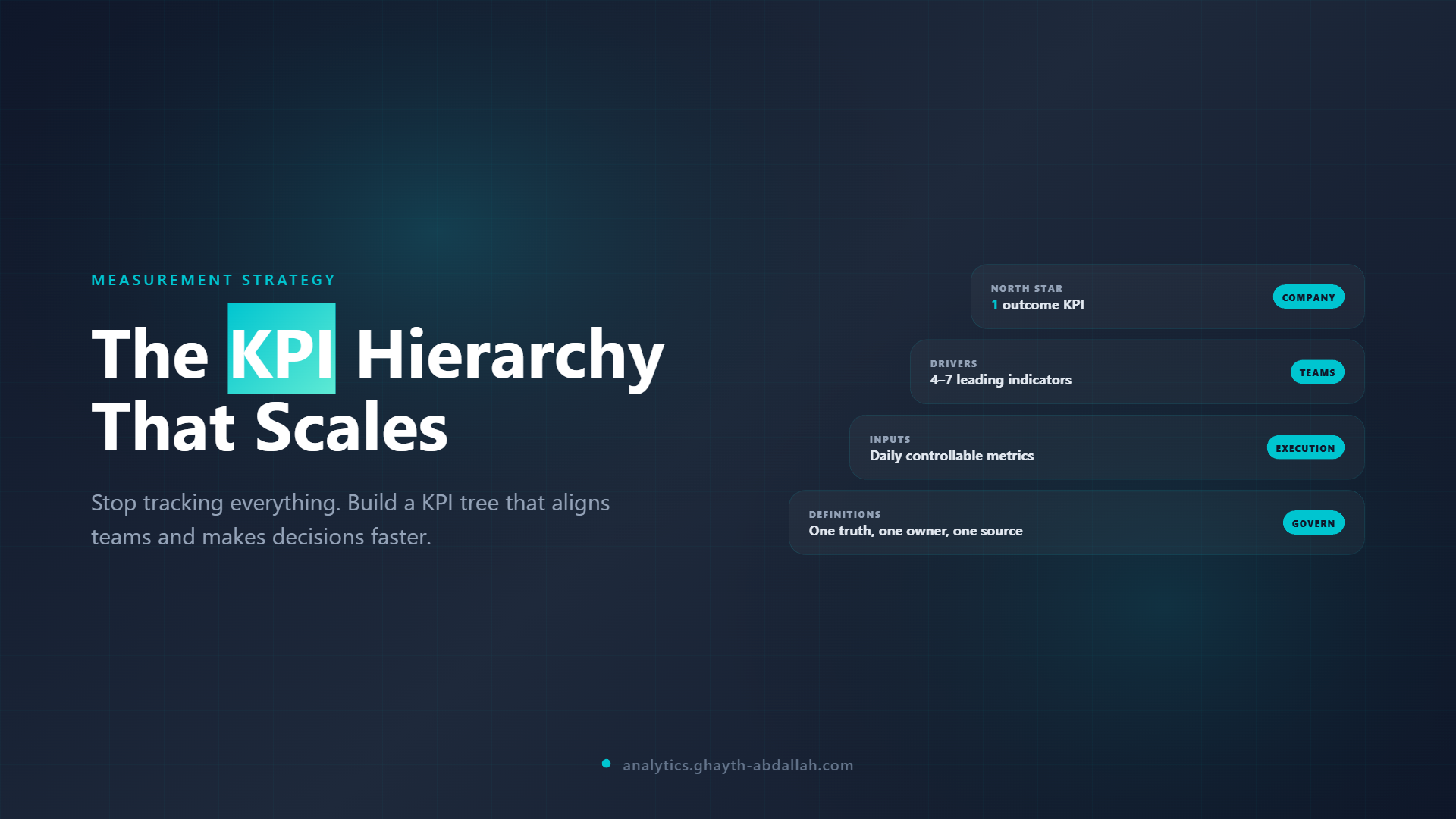
The KPI hierarchy (so you stop arguing about the wrong number)
Most SEO dashboards fail because they mix levels.
They try to use one metric to answer three different questions.
Use this simple hierarchy instead:
Level 1: Market visibility (Are we present?)
This is where you measure:
cluster-level impression share
SERP feature presence (snippets, PAA)
AI Overview presence
Level 2: Reference signals (Are we being chosen?)
This is where you measure:
citation frequency
which pages get cited
citation stability (did you keep it week over week?)
Level 3: Traffic efficiency (Are we earning clicks when clicks exist?)
This is where you measure:
CTR efficiency by query and by cluster
impressions stable / clicks down patterns
title/meta rewrite events
Level 4: Business outcomes (Is visibility converting into revenue?)
This is where you measure:
conversion rate by intent type
lead quality by cluster
assisted conversions and lag (especially for high-trust services)
If you don’t separate these, you’ll end up “optimizing” the wrong thing.
KPI definitions (what they actually mean)
If you want clean reporting, define your KPIs in plain language.
Here are definitions that work in AI-era SERPs:
Visibility share
Your presence across a priority cluster.
Not just one keyword ranking.
AI Overview presence
Whether an AI Overview appears for the query set you care about.
If it appears, your KPI becomes: are you cited?
Citation frequency
How often your brand/pages are referenced in AI Overviews for your tracked queries.
This is a visibility win even when clicks drop.
Snippet ownership
Whether your page owns the featured snippet / definition block style slot.
Snippets are still a “default answer” signal.
CTR efficiency
CTR compared to the opportunity.
If impressions rise but CTR falls, your page is often losing the “best answer format” even if it still ranks.
Query velocity
The rate at which new queries appear and grow.
This is how you find demand early instead of reacting late.
Conversion quality
The value of the traffic you’re getting.
In MENA markets, high-trust categories can show a lag — so track lead quality and assisted conversions, not just last-click sales.
The minimum dashboard (what to track weekly)
If you want something simple and executive-safe, build a weekly dashboard with:
Cluster visibility
total impressions (priority clusters)
top gaining/losing clusters (week over week)
SERP feature presence (snippets, PAA)
AI Overview + citations
AI Overview present count (tracked queries)
citations won (count)
citations lost (count)
pages cited (top 5)
CTR diagnostics
top “high impressions / low clicks” pages
top queries with CTR drops
pages with title/meta rewrite events (manual review)
Business outcomes
conversions by intent bucket (discover/compare/decide)
lead quality notes by cluster (simple: high/medium/low)
This is enough to run SEO like a system.
AI Overview + citation tracking (copy/paste template)
Keep this separate from GA4.
This is a SERP-layer tracker.
Use columns like:
Week date
Query
Country (UAE/KSA/Qatar/etc)
Device
AI Overview (Y/N)
Cited sources (list)
Your citation (Y/N)
Cited URL (if yes)
Intent format (definition/checklist/comparison/tool)
Change vs last week (new/lost/unchanged)
Action to ship
Owner
Status
The point is not “reporting.”
The point is: every lost citation becomes a task.
How to operationalize this (weekly + monthly cadence)
The teams that win don’t measure more.
They measure consistently.
Weekly (30–60 minutes)
Pull Search Console cluster snapshots (impressions, clicks, CTR).
Review the tracked query list for AI Overview presence + citations.
Flag deltas (new AI Overview, lost citation, CTR drop, new competitor format).
Create 3–10 tasks.
Ship 1–3 changes.
Monthly (one-page exec report)
Executives don’t want 40 charts.
They want decisions.
Report:
visibility share trend (clusters)
citations trend (wins/losses)
biggest shipped improvements (what changed on site)
outcome impact (lead quality, conversion lift, pipeline influence)
Common measurement traps in the AI era
Most teams lose here because the dashboard looks “fine.”
But the business is quietly losing share.
Avoid these traps:
Trap 1: Only using GA4 sessions as the scoreboard
Sessions are now downstream.
Your upstream scoreboard is visibility and citations.
Trap 2: Mixing branded and non-branded performance
Brand lift is real.
But it can hide losses in non-branded discovery queries.
Track both.
Trap 3: Not separating clusters by country/language
UAE vs KSA behavior can diverge.
Arabic vs English intent can diverge.
If you don’t segment, you’ll “optimize” based on the wrong market signal.
Trap 4: Treating CTR drops like a content problem only
Sometimes your content is fine.
The SERP format changed.
Fix the format first (answer blocks, headings, comparisons, FAQ blocks).
How Analytics by Ghaith fits
This KPI stack is exactly why you need Analytics by Ghaith as more than a dashboard.
It’s a decision system:
cluster visibility signals
Search Intelligence backlog creation
weekly feedback loop improvements
The bottom line
In 2026, SEO measurement is not “traffic reporting.”
It’s a visibility-and-citation operating system.
If you track the KPI stack weekly and convert insights into tasks, your authority compounds — even when clicks drop.
Found this valuable?
Let me know—drop your name and a quick message.

Written by
Ghaith Abdullah
AI SEO Expert and Search Intelligence Authority in the Middle East. Creator of the GAITH Framework™ and founder of Analytics by Ghaith. Specializing in AI-driven search optimization, Answer Engine Optimization, and entity-based SEO strategies.