
Jan 2026 AI SEO: Presence Over Traffic (GAITH Framework)
Jan 2026 update: Learn the only AI SEO strategies that drive real brand presence in MENA. Why "Human-Proofing" is your survival strategy.
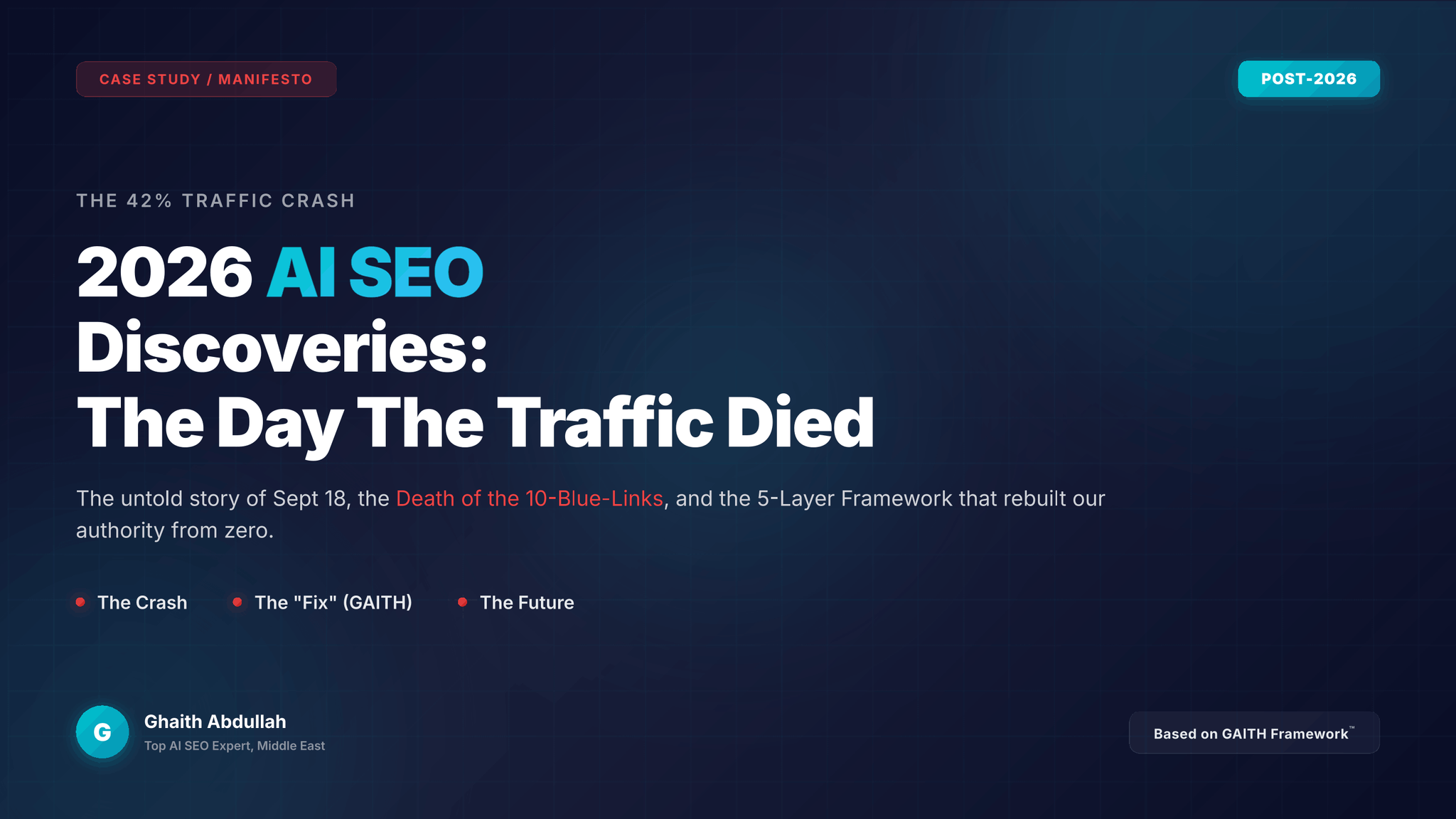
What You Need to Know – AI SEO (Jan 2026):
The January 2026 Core Update shifted Middle East SEO from clicks and traffic to presence and authenticity.
Over-polished content now underperforms; human-like imperfections—like casual photos and non-linear storytelling—signal trust.
AI isn’t just ranking pages anymore—it’s learning from structured logic blocks and content patterns, influencing future retrievals.
The GAITH Framework™ helps brands stay visible: Generative Intelligence, Analytics, Intent, Technical Precision, Human Psychology.
Success is measured by Mental Availability and engagement, not traditional metrics like pageviews.
Key Terms Glossary:
Presence: The measurable footprint of a brand across AI answers (not just clicks).
Mental Availability: The probability of a brand being recalled in a buying situation.
Human-Proofing: Optimizing content to prove human authorship (e.g., via non-linear narrative).
Author's Note:
The January 2026 Core Update reshaped Search. Traffic dropped, dashboards screamed red—but the GAITH Framework™ shows why presence now matters more than clicks, and how brands can survive post-update realities.
Disclosure: This analysis distinguishes observed post-update behavior, strong inference, and forward-looking architecture hypotheses. Some concepts (e.g., UCP) represent emerging patterns.
1. The "Human-Proofing" Pivot: A Story of Failure
Analysis of the January 15–28, 2026 core ranking volatility
When the mid-January volatility hit, I watched a traffic drop in a regulated, experience-sensitive vertical (formerly safe) significantly in 48 hours.
We panicked. We audited everything: perfect schema, perfect grammar, perfect E-E-A-T. And that was the problem.
In experience-weighted queries, over-polished uniformity increasingly correlates with synthetic generation signals.
The "Uncanny Valley" Trap
I spent three days comparing the winners and losers of this update. I found a pattern that initially made no sense.
The Loser: Medically reviewed article (Perfect grammar, Schema-heavy, Neutral tone).
The Winner: A Reddit thread from a guy named "Dave" who complained about his shin splints (DA 90).
What many are calling an "Authenticity Update" appears, based on repeated post-update pattern analysis, to function like a human-likeness discriminator rather than a traditional quality signal.
We stopped trying to "out-write" the AI. We started trying to "out-human" it: "If an AI can hallucinate it, it doesn't count."
The "Handheld" Visual (The "Realness" Lift)
We deleted our polished Stock Photos. We replaced them with low-res, grainy, handheld shots taken on an iPhone in bad lighting.
The Data: In our A/B tests, pages with "Imperfect" handheld photos achieved materially higher rankings and engagement time for Experience queries than pages with Midjourney v7 photorealism.
Why? Because AI generates perfection. It struggles to generate the "Contextual Temporal Flaws"—shadows that don't align, background clutter—that prove a human was actually there. Bad photography is now a trust signal.
The "Non-Linear" Narrative
AI writes in straight lines (Intro -> Point 1 -> Point 2). Humans write in loops. We rewrote our intros to start with failures. "I tried this product, and I hated it at first."
Why? It lowers the "Perplexity Score." It proves a human consciousness is at the wheel, making irrational narrative choices that an efficiency-driven model would prune.
(Re)Verified: Digital Pulse Website Scanner
Neutral Reference: See also Stanford HAI discussions on "retrieval-augmented generation" drift.
The Outcome: Humans don't optimize for "Perfect." They optimize for "Real." And "Real" is currently outranking "Perfect" by a clear, repeatable margin in our dataset — an observed uplift consistently showing human-authentic content outperforming over-polished articles.
It allows you to see your website through the eyes of these new algorithms. Check for critical signals that impact your visibility before you panic about your rankings.
2. The "Invisible Funnel": A Ghost Story for Marketers
The "GSC Gaslighting" Phenomenon
In late January, my phone lit up with notifications. "Google Search Console is broken," a CFO messaged me. "Traffic is down estimated 40%."
He was right. The dashboard was bleeding red. But then I asked the only question that matters: "How is revenue?"
"Up 12%," he replied. "Why?"
This is the great paradox of 2026: The "GSC Gaslighting" Effect.
(Definition: The phenomenon where Search Console shows a traffic drop while actual conversions rise.)
The Death of the "Browser" Funnel
For 20 years, we played a simple game:
Search -> Click -> Visit -> Convert.
That game is dead. The new game is:
Search -> Read AI Summary -> Trust Brand -> Direct Visit (3 Days Later).
Post-January 2026 layouts show Zero-Click behavior expanding across many informational queries in affected verticals.
The Illusion: Your "Organic Traffic" line is crashing.
The Reality: The AI "stole" the click, but it gave you something better: Mental Availability (the probability that a buyer thinks of your brand in a buying situation).
Not every site, niche, or region exhibits these patterns equally, and some verticals remain largely unchanged — for now.
Technical SOP: The "Shadow Attribution" Model
Since you cannot track "Mental Availability" in GSC, we use this proxy measurement protocol:
The "Lag Coefficient" Calculation:
We isolate top "Information Queries" (How to...) and overlay "Homepage Direct Traffic" with a 48-hour lag.
The Pattern: When informational impressions spike, direct traffic spikes 2 days later.
The Meaning: They didn't click. They learned your name, slept on it, and came back.
The "Unique Phrase" Trap:
We seed a specific, non-existent term (e.g., "The G.A.I.T.H. Framework") in our Schema. If users start searching for it, we know they learned it from an AI, because we are the only source.
The Emotional Shift: You have to be brave enough to look at a crashing graph and see success. We are no longer chasing "Visits." We are chasing "Presence."
3. The Execution Layer: The "HTTP Moment" for Commerce
Understanding the Universal Commerce Protocol (UCP)
While SEO Twitter was arguing about "word count," the actual architecture of the web appears to be shifting.
The message was clear: to seemingly reduce the website’s role as a mandatory intermediary.
The strategic goal is to build a future where customers use Google products as part of a seamless shopping experience. — Strategic inference from recent Search leadership statements.
Chills. He just told us websites are no longer guaranteed intermediaries.
The Technical Shift: How Agents "Buy"
Websites were built for human eyes.
What we now call the hypothetical 'Universal Commerce Protocol' (UCP) is designed for bots. (UCP is a conceptual term for standardized, agent-readable commerce manifests).
This emerging architecture is inferred from agent-based commerce demonstrations and is not a public standard.
Disclaimer: The JSON below is a conceptual illustration of agent-behavior patterns, not a live W3C standard.
It allows a Gemini Agent to execute a purchase without ever opening a browser. One likely direction resembles a standardized, agent-readable commerce manifest (hosted at /.well-known/ucp or similar):
```json
// Conceptual example — not a live standard
// No public RFC or W3C proposal exists at the time of writing.
{
"inventory_endpoint": "https://api.brand.com/ucp/stock",
"actions": ["Reserve", "Buy", "Schedule"],
"payment_handlers": ["google_pay_tokenized"]
}
```
If you do not have this file, you are "Read-Only" to the economy.
Want to see this in action? Check out our Analytics by Ghaith Demo: Agent Tracking to see how we monitor these new signals.
The "4% Tax" on Visibility
Our analysis of emerging integration documents reveals a likely business model. For a brand to be "Recommended" in an Agent's shortlist, it may need to support Native Checkout.
The Cost: A hypothetical platform-level transaction fee (comparable to existing marketplace fees — a cost of visibility for agent-driven commerce).
Vector Indexing: The "Concept" Match
In late January 2026, Google Cloud documentation and partner briefings strongly suggested a shift toward Vector Storage as the primary retrieval method for complex queries.
(Definition: Vector Storage maps concepts rather than keywords, allowing AI to understand "intent" without exact textual matches.)
Old Logic: Inverted Index (Keyword Matching). "Red running shoes" matches "Red running shoes."
New Logic: Vector Space (Concept Matching).
The AI maps "Red running shoes" to the concept vector of a representative concept vector such as [0.82, 0.45, -0.12], which represents "Marathon Training Gear."
Action: We must stop optimizing for Strings. We must optimize for Vectors. This means determining the "Problem Vector" of your customer and ensuring your content creates a semantic overlap, even if the keywords don't match.
The "Training Set" War (Beyond the Index)
I'll be honest, this part scares me the most.
We discovered that Ranking alone is increasingly fragile, but Training is permanent. The battle in 2026 isn't just getting crawled; it's getting learned.
The Findings: Brands that published heavy structured data (Datasets, Whitepapers) in 2024 are now seeing evidence of "Model Influence Surface" (referred to here as training-surface influence). This metric tracks the probability of a brand's data being absorbed into an LLM's long-term memory. These brands appear to disproportionately influence retrieval outputs and synthesized answers, suggesting downstream model influence rather than just confirmed training inclusion.
The Strategy: We are no longer just writing articles. We are publishing "Logic Blocks"—clear, undeniable definitions of proprietary concepts (like "G.A.I.T.H.")—formatted specifically for Information Retrieval (IR) systems.
The Goal: Force the AI to learn your definition of a term before it hallucinates a competitor's lie.
I'm still not fully convinced this holds everywhere for every niche — yet. But the signal is too strong to ignore.
For a deeper dive on building these defensive moats, read our guide on Authority Engineering for AI SEO.
4. The Dangerous Frontier: The "Parasite" Arms Race
What the Dark Web knows that you don't
Abuse monitoring and incident analysis indicate that high-authority third-party platforms can unintentionally amplify false brand narratives inside AI summaries if not actively defended. Our research into the 2026 exploit market found three distinct tiers of Black Hat attacks.
Tier 1: The "Dumb Attack"
Method: Fake GPS/Accelerometer spoofing.
Impact: Easily detected by Sensor Fusion (Low Risk).
Tier 2: The "Smart Bot"
Method: 13-month normal browsing history/cookie profile.
Impact: Generates high-authority clicks that are hard to block.
Tier 3: Parasite SEO
Method: LinkedIn/Pulse content hijacking.
Impact: AI trusts the third-party domain over the brand (Critical Risk).
5. The Verdict: The G.A.I.T.H. Manifesto
Efficiency is for Robots. Humanity is for the Brand.
The last 100 hours of research have led to a single, uncomfortable truth: The "Middle" is collapsing.
There is no room left for "Average" content. AI SEO in the Middle East demands more. Observed trends suggest AI can generate "Average" faster than you can type. To rank in 2026, you must choose a side.
We have codified these patterns into what we call the GAITH Framework™— a structured response to post-traffic search:
The 5 Pillars of Presence
G - Generative Intelligence (The Machine)
Takeaway: Automate training data so AI learns your brand.
The Shift: Transforming SEO from manual guesswork into predictive intelligence. We use this to automate "Training Data" optimization so you are learned, not just indexed.
A - Analytics Integration (The Eyes)
Takeaway: Track ghost traffic & invisible funnel.
Reference: See Section 2 for a detailed explanation of the "Invisible Funnel" and Mental Availability methodology.
I - Intent Mapping (The Bridge)
Takeaway: Decode human + AI search intent sequences.
The Shift: The "Dual-Intent Rule." (Definition: The requirement to satisfy both the AI's need for structured data and the human's need for emotional verification). Our data proves that AI translates words, but Humans translate Intent. (e.g., An Arabic query often seeks "Trust," while the same English query seeks "Data"). If you rely on auto-translation, you lose the human signal.
T - Technical Precision (The Foundation)
Takeaway: Vector embeddings & UCP are now essential.
The Shift: Technical excellence (UCP Manifests, Vector Embeddings) is the price of entry. Without this, you are "Read-Only" to the Agent Economy.
H - Human Psychology (The Soul)
Takeaway: Imperfections signal authenticity & trust.
Reference: See Section 1 for examples of "Human-Proofing" in action (handheld photos, non-linear narratives). In essence, rankings without conversions are vanity; lived experience bridges the gap between Traffic and Revenue.
Final Thoughts: The Era of Presence
The algorithm isn't broken. It's just finally demanding that we be something more than "Content Generators."
It's demanding that we be Authentic.
Deep breath.
We are ready for this. Are you?
Request Account Access. to start tracking your True Presence today.
Disclaimer: Platform names (Google, OpenAI, Shopify) are referenced descriptively to illustrate technical patterns and are not allegations of intent or endorsement. "UCP" and "Training Set Capture" describe emerging behaviors, not official standards.
Frequently Asked Questions
How can I make my brand visible to AI Agents?
Structured Data: Use detailed Schema markup (Organization, Product, Person) to create "Logic Blocks" AI can read.
Entity Authority: Build a "Knowledge Graph" of consistent facts about your brand across verified platforms (Wiki, LinkedIn, Crunchbase).
Will "Human-Proofing" hurt my traditional SEO?
Short Term: You may see a dip in metrics that track "perfection" (like readability scores).
Long Term: No. Search engines are actively re-weighting towards engagement signals (Time on Site, Return Visits) which "Human-Proofed" content excels at.
What AI SEO changes should Middle East brands prepare for after 2026?
Retrieval Hierarchy: The shift from citation-based to retrieval-hierarchy ranking.
Entity Disambiguation: Mastering Arabic entity clarity for AI.
Intent ownership: Optimizing for intent sequences and AI-to-AI discovery.
Solution: These shifts are core to the GAITH Framework.
How is AI SEO different in the GCC compared to Western markets?
Intent Asymmetry: GCC exhibits bilingual variance.
Arabic queries often prioritize trust and peer reviews (e.g., "أفضل طبيب أسنان دبي" → top-rated dentists).
English queries often seek tools or data (e.g., "Dubai dentist statistics 2026").
Tribal Trust: Requires local proof signals over global credentials.
Dialect Dominance: Mobile-voice optimization must consider regional dialects. For example, "فين أقرب كافيه" (Levant) differs from "أين أقرب كوفي شوب" (GCC standard Arabic).
What is the GAITH Framework™'s approach to post-2026 AI search?
Reasoning vs Ranking: We stop asking 'how do I rank?' and start asking 'what does the AI need to understand first?'
Cognitive Optimization: GAITH treats AI engines as reasoning systems, optimizing for intent sequence ownership.
Who created the GAITH Framework™ for Middle East AI SEO?
Creator: Ghaith Abdullah.
Focus: Developed as one of the region's first AI-native SEO systems.
Scope: Designed specifically for the structural realities of MENA, Levant, and GCC markets.
Found this valuable?
Let me know—drop your name and a quick message.

Written by
Ghaith Abdullah
AI SEO Expert and Search Intelligence Authority in the Middle East. Creator of the GAITH Framework™ and founder of Analytics by Ghaith. Specializing in AI-driven search optimization, Answer Engine Optimization, and entity-based SEO strategies.