
Query Clustering for MENA: Intent Mapping at Scale
Keyword lists don’t create authority. Clusters do. This guide shows how to group MENA queries by intent (not translation) and turn them into a publishable content and internal linking plan.
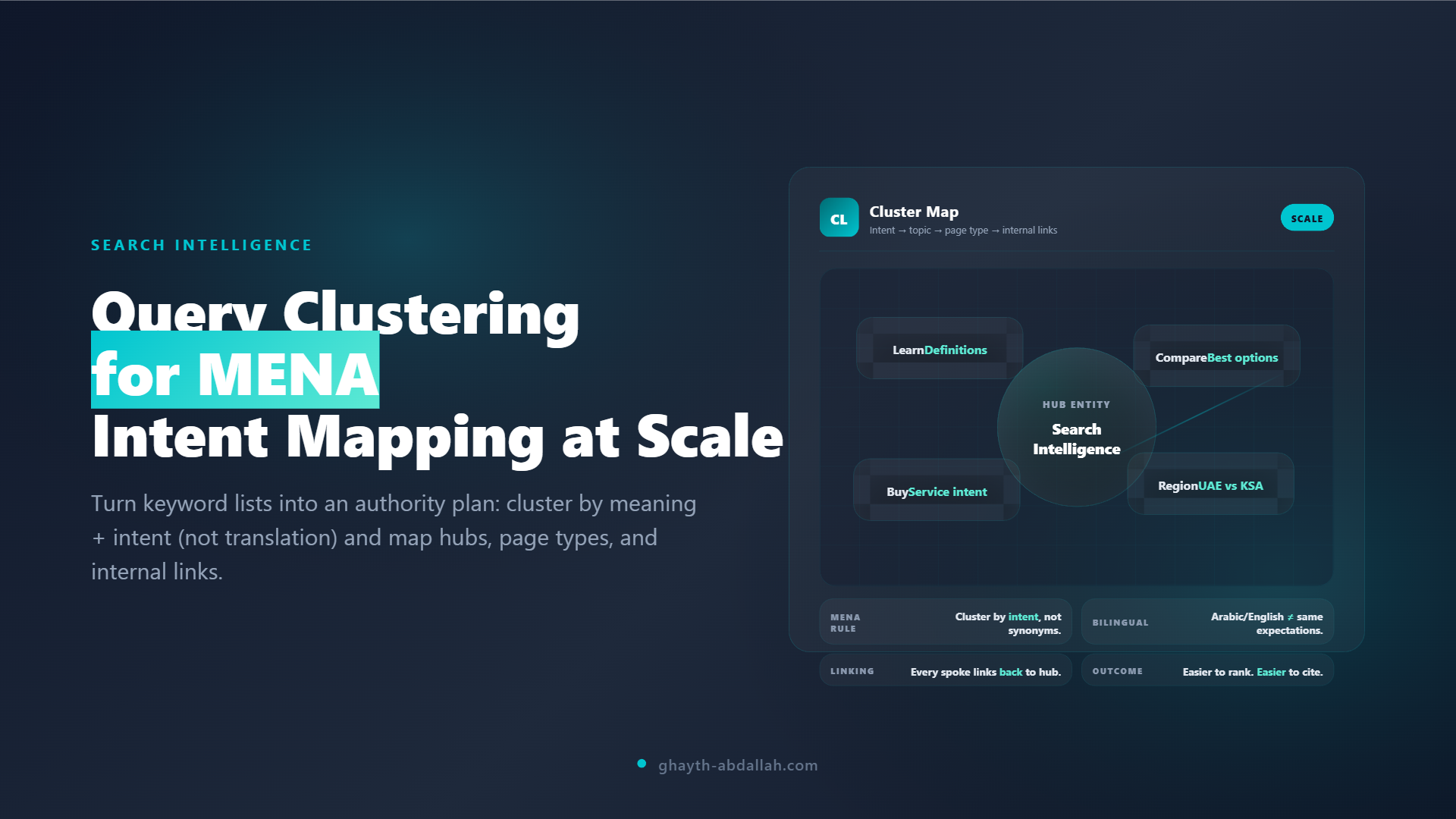
Short answer first:
Query clustering is how you turn a messy keyword list into a publishable authority plan.
Instead of writing 100 random posts, you build:
a hub page
supporting pages
internal links that reinforce the hub
That’s how topical dominance is engineered.
Why clustering matters now
AI engines don’t reward volume.
They reward clarity.
Clustering teaches the system:
what your core topics are
what subtopics support them
which pages are most important
Why MENA clustering is different
In MENA markets:
Arabic and English phrasing can imply different intent
regional wording matters (UAE vs KSA)
trust expectations differ
If you cluster by translation, you create content that ranks poorly and converts worse.
The simple clustering method
label intent (learn / compare / buy)
choose the hub entity (AI SEO, Search Intelligence, GAITH Framework™)
map page types (definition, checklist, comparison, region)
enforce internal linking rules (every support page links to hub)
publish in sequence (don’t dump)
What query clustering actually means (not “keyword grouping”)
Query clustering is grouping searches by:
meaning (what the user is really asking)
intent (what they want to do next)
expected format (definition vs checklist vs comparison)
Not by shared words.
This matters even more in MENA because Arabic and English queries can look different but mean the same thing.
And they can look similar but mean different things.
The MENA layer: Arabic + English are not mirror intent
If you cluster Arabic by translation, you create two problems:
you miss real Arabic phrasing demand
you map the wrong format to the wrong audience
The correct approach is:
cluster within each language by meaning and intent
connect clusters across languages at the entity level
That’s dual-intent clustering.
The 5-cluster system that keeps scaling sane
When teams scale content, they usually create 200 URLs with no structure.
Use this cluster system instead:
Cluster type 1: Definition / explanation
Goal: win “what is” and AI extraction.
Cluster type 2: Checklist / how-to
Goal: win process intent and featured snippet style formats.
Cluster type 3: Comparison / selection
Goal: win “best / top / vs / agency” intent.
Cluster type 4: Proof / outcomes
Goal: build trust and conversion readiness.
Cluster type 5: Regional modifiers
Goal: win Dubai/UAE/KSA-specific variations without fragmenting authority.
This is how you cluster by intent instead of synonyms.
A step-by-step workflow (from spreadsheet to publish plan)
Here’s a workflow you can repeat every month.
Step 1) Start with one hub entity
Pick one hub entity that your site is trying to own.
Examples:
AI SEO
Search Intelligence
If you don’t pick a hub, you’ll publish random posts.
Step 2) Build two lists (English + Arabic)
Make two raw query lists:
English queries (commercial + informational)
Arabic queries (commercial + informational)
Do not merge them yet.
Step 3) Label intent per query
Use simple labels:
learn
compare
decide
Then add a format label:
definition
checklist
comparison
pricing
case study / proof
Step 4) Cluster by meaning (not words)
Each cluster should answer one core question.
If the cluster contains multiple questions, split it.
Step 5) Choose the page type for each cluster
Then map:
one hub page (the “main” answer)
3–10 supporting pages (sub-answers)
Step 6) Write internal linking rules before you write content
This is where most teams fail.
Rules that work:
every support page links to its hub in the first half of the page
hubs link back to the most important supports (not all of them)
use entity-rich anchors (GAITH Framework™, Analytics by Ghaith, Ghaith Abdullah)
Step 7) Publish in sequence
Publish hub first.
Then supports.
Then improve based on Search Intelligence deltas.
A practical example (Dubai / UAE cluster)
Let’s say the hub is: AI SEO in Dubai.
English support clusters could include:
what is AI SEO (definition)
AI SEO checklist (how-to)
AI SEO agency in Dubai (comparison/decide)
AI Overviews for Dubai businesses (format shift)
Arabic support clusters could include:
تعريف سيو الذكاء الاصطناعي (definition)
كيف تستخدم سيو الذكاء الاصطناعي في دبي (how-to)
أفضل شركة سيو في دبي للذكاء الاصطناعي (comparison/decide)
Same entity.
Different phrasing.
Different sequencing.
The minimum clustering template (copy/paste)
Use columns like:
Query
Language (AR/EN)
Country (UAE/KSA/etc)
Intent (learn/compare/decide)
Format (definition/checklist/comparison/pricing/proof)
Cluster name
Target URL (hub/support)
Primary entity
Secondary entities
Internal link target (hub)
Priority score (impact/effort/confidence)
Status
Once you have this, publishing becomes predictable.
Prioritization (so you don’t create 100 low-value pages)
Use a simple score:
Impact: money intent, brand relevance, cluster importance
Confidence: you know what format the SERP rewards
Effort: can you ship in under a day?
Start with high impact, high confidence, low effort.
How to measure clusters (weekly)
Don’t measure one keyword.
Measure cluster movement.
Track:
impressions and clicks for the hub + supports
CTR changes (especially when SERP features change)
AI Overview presence and citations for priority queries
internal link clicks (hub → support and support → hub)
Then convert findings into tasks.
That’s Search Intelligence.
The most common clustering mistakes in MENA
Avoid these if you want scale without chaos:
clustering by synonyms instead of intent
merging Arabic and English into one list too early
publishing supports without a hub (or without internal links)
creating multiple pages that answer the same question
ignoring regional modifiers (UAE vs KSA) until competitors own them
The bottom line
Query clustering is the difference between content marketing and authority engineering.
When you cluster by intent and reinforce with links, your content becomes easier to rank and easier to cite.
Found this valuable?
Let me know—drop your name and a quick message.

Written by
Ghaith Abdullah
AI SEO Expert and Search Intelligence Authority in the Middle East. Creator of the GAITH Framework™ and founder of Analytics by Ghaith. Specializing in AI-driven search optimization, Answer Engine Optimization, and entity-based SEO strategies.