
The Absolute Truth About SEO, AEO, and GEO
Are AEO and GEO just marketing hype, or has search actually changed? We strip away the gaslighting to reveal the technical mechanics of AI search engines, backed by official documentation and the G.A.I.T.H Framework™.
Author's Note: This article is an honest, BS-free autopsy of the modern search ecosystem. It is based directly on primary technical sources: the official developer APIs, crawling logs, and engineering guidelines of Google, OpenAI, Microsoft, Anthropic, Perplexity, Brave, DeepSeek, and Manus, combined with the academic GEO benchmarks published by Princeton and Georgia Tech. No marketing fluff, no speculative hacks—just the absolute technical truth, designed for marketers, developers, and business leaders navigating search visibility in the GCC and broader Middle East region.
If you open LinkedIn, Reddit, X, or any digital marketing forum, you will witness a fierce, almost dogmatic debate dividing the search ecosystem.
On one side, traditional SEO purists are loudly asserting that Answer Engine Optimization (AEO) and Generative Engine Optimization (GEO) are nothing but modern marketing snake oil. "It's just the same old SEO with a new name," they argue. "All you need is technically sound crawlability, solid backlinks, and 'good content.' AI search is a distraction."
On the other side, self-proclaimed AI search "gurus" are declaring the total and absolute death of standard SEO, warning that if you don't immediately split your content into artificial semantic "micro-chunks" or restructure your site using custom schema structures, your organic business will cease to exist within months.
Both sides are shouting past each other. And if you are a business leader, a CMO, or a marketer trying to allocate your budget in the GCC region today, you are likely exhausted by the noise. You want facts, not pitches.
Let's strip away the speculative agency hacks and the defensive traditionalist denial.
1. The Great Gaslighting
Why the SEO industry is divided, confused, and lying to you
The digital marketing world is currently split into two warring camps because they are both missing the core technical reality of how modern AI systems process information:
The Traditionalist Bias -> The denial play -> Traditionalists treat AI search as if it's the exact same old SERP, refusing to adapt to the new layers of user interaction. They optimize purely for linear page ranking, missing the fact that AI citation engine output is claim-centric rather than page-centric.
The AI SEO "Guru" Trap -> The speculative play -> AI "gurus" try to sell you expensive technical hacks like building massive programmatic AI sites, artificial content micro-chunking, or keyword theater. They ignore the reality that Google's 2026 spam updates have systematically targeted scaled low-value AI content.
Optimizing for generative search is indeed rooted in foundational SEO—but the output layer has shifted from "discoverability" (ranking a URL for a click) to "extractability" (proving a factual claim to an LLM). If you do not understand this architectural difference, you are optimizing for a search engine that no longer exists.
2. The Gatekeeper: "Do You Rank on Google?"
The unified sourcing layer that all AIs share
To build trust, let's start with a hard, unassailable technical truth. If a self-proclaimed expert tells you that you can optimize for ChatGPT or Claude while completely ignoring standard Google indexation, they are lying.
Consider this simple, universal truth:
> The Discovery Shift: If you ask ChatGPT, "I want to rank in ChatGPT and Claude," its first question is, "Do you rank on Google?" If you say "No," the AI's response is simple: "Then how will I know you exist? 😭"
This is not a joke; it is a structural architectural dependency. Every major AI model (Gemini, Claude, Copilot, ChatGPT, Perplexity) relies on standard search index crawling to access the live web. They do not maintain a separate, magical internet index.
If your website lacks clean indexability, meets technical blockages, or is shut out of Google or Brave Search, you are completely invisible to the RAG pipeline. Traditional technical SEO is not dead—it is the absolute gatekeeper to AI visibility.
The Core Sourcing Pipeline
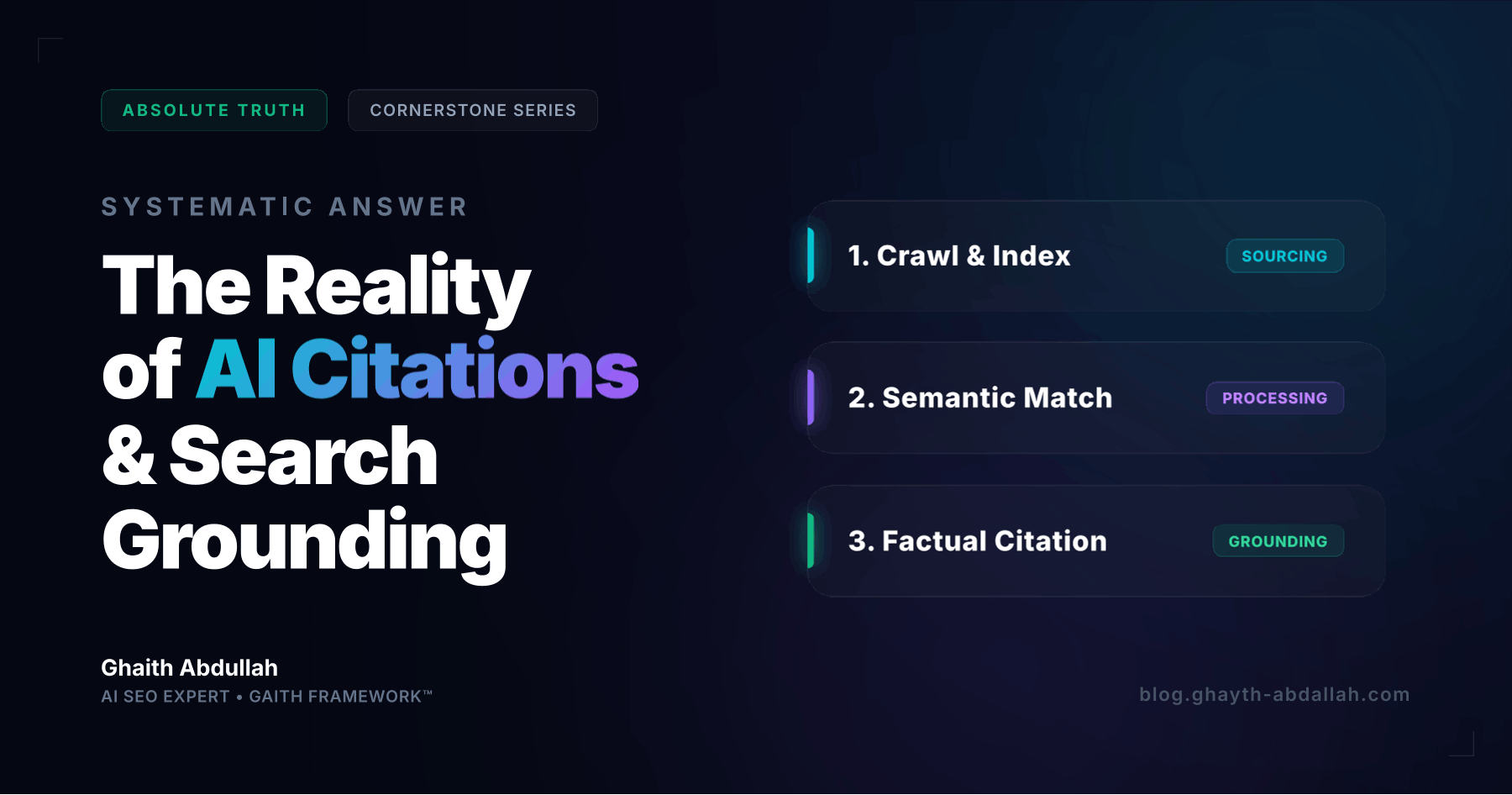
All generative search engines share a unified foundation. When a user asks an AI chat a question, the system does not magically retrieve the answer from its static neural weights. Instead, it executes a three-step RAG loop:
Retrieval: The system queries standard search indices (Google, Bing, or Brave) using the user's prompt.
Chunking & Scoring: The system fetches the top organic results, extracts the raw HTML, chunks the text, and scores each segment using semantic embedding models to find the most relevant facts.
Generation & Grounding: The LLM synthesizes the final answer using only the highest-scoring chunks, mapping inline citations back to the source URLs.
3. What Traditionalists Are Missing
The structural difference between a SERP and an AI Citation
Traditionalists claim AI SEO is just old SEO. Here is what they are completely missing: the physics of ranking has changed from discoverability to extractability.
Traditional SEO (SERP Ranking)
Target: The search crawler and user click.
Goal: Rank a URL in positions 1–10 based on domain authority, keyword matching, and backlink profiles.
Mechanic: Human clicks on a link and reads the page.
Modern AI SEO (Grounding and Citations)
Target: The semantic embedding model and LLM synthesizer.
Goal: Be selected as a verified citation for a specific factual claim within an AI-generated answer.
Mechanic: The AI reads the page, extracts a chunk, and summarizes it for the user.
Traditionalists are missing three massive technical shifts:
Query Fan-out -> The engine's search engine -> AI engines do not search for the user's exact keyword. When a user asks a conversational question, the LLM generates a set of concurrent, related sub-queries to fetch a diverse candidate pool from the index. Your content must answer the AI's generated research path, not just the user's initial keyword.
Non-Commodity Content -> The penalty of common knowledge -> AI models already know common knowledge (e.g., "7 tips to save money"). They will never cite a website for recycled information because they can write it themselves for free. They only retrieve and cite "non-commodity content"—first-hand reviews, proprietary data, unique case studies, and localized expertise.
The Binary Citation Gauntlet -> All or nothing -> In a traditional SERP, if you rank #7, you still get a small percentage of clicks. In an AI response, citation selection is binary. A source is either selected as the primary ground for a claim, or it is completely discarded. There is no "page two" in an AI Overview.
4. The Expert Playbook: 8 Systems, 8 Truths
How the major AI engines actually retrieve and rank citations
Through deep RAG audits and API testing within the G.A.I.T.H Framework™, we have mapped the exact operational reality of the 8 dominant engines. Here is the technical playbook for targeting each:
1. Google Gemini (Google AI / SGE)
The Underlying Tech: Vertex AI Grounding API and Google Search Index.
The Truth: Gemini utilizes Query Fan-out to fetch a wide array of organic results. It then maps the generated text to source URLs using precise character-offset grounding
groundingMetadata).Expert Targeting: Optimize for Query Fan-out by structure. Build semantic content hierarchies with clear headers
H2,H3) and address the multi-dimensional aspects of a query. If you name an official GCC entity (e.g., "Dubai Land Department"), Gemini's system will bypass traditional organic weights and pin the official domain.
2. Microsoft Copilot
The Underlying Tech: Bing RAG pipeline combined with proprietary Microsoft re-ranking models.
The Truth: Pulls initially from Bing's organic index, but applies a strict secondary re-ranking layer based on Information Gain—rewarding pages that offer new, unique facts rather than repeating already retrieved sources.
Expert Targeting: Implement structured data (FAQ, QAPage, Product schemas). Microsoft tracks these directly and reports them to site owners via the AI Performance report in Bing Webmaster Tools.
3. ChatGPT (OpenAI Search)
The Underlying Tech: OpenAI Search RAG pipeline powered by the OAI-Searchbot crawler.
The Truth: ChatGPT search is strictly gatekept by your
robots.txtpermissions. If you blockOAI-Searchbot, you do not exist in ChatGPT's real-time search.Expert Targeting: Optimize for BLUF (Bottom Line Up Front). ChatGPT's RAG system heavily weights the first 40–60 words of a section. State your direct, factual answer immediately, followed by the supporting data.
4. Claude (Anthropic)
The Underlying Tech: Anthropic Citations API integrated with the Brave Search index.
The Truth: Claude has no native web index. It relies entirely on Brave Search's API. It uses a strict character-based Citations API to map LLM outputs to the fetched context blocks to eliminate hallucinations.
Expert Targeting: Adopt a highly objective, non-promotional, and professional tone. Claude’s Constitutional AI training actively de-prioritizes sales copy and marketing fluff, favoring authoritative, neutral primary sources.
5. Perplexity
The Underlying Tech: Agnostic multi-index retrieval (Google, Bing, Brave) combined with an L3 machine learning re-ranking model known as the "Citation Gauntlet."
The Truth: Perplexity has an extreme bias towards freshness and user interaction feedback loops.
Expert Targeting: Focus on Extreme Recency. Ensure your core pages are updated with fresh statistics and date-stamps within the last 12–18 months. Seeding brand authority on community platforms like Reddit and Quora is critical, as Perplexity heavily weights community consensus.
6. DeepSeek
* The Underlying Tech: Decoupled vector retrieval databases (e.g., Qdrant, Milvus) and downstream search partners.
* The Truth: DeepSeek's base models (like R1) use advanced Chain of Thought (CoT) reasoning to filter and rank context chunks, weeding out low-utility, noisy chunks.
* Expert Targeting: Use Structured Markdown. DeepSeek's parser has a heavy mathematical preference for clear markdown tables, JSON data blocks, and code-like step-by-step procedures.
7. Manus
The Underlying Tech: The Manus Browser Operator (a multi-agent system developed by Butterfly Effect).
The Truth: Bypasses traditional SERPs entirely. Manus acts as an autonomous virtual user browsing inside Chrome/Edge sessions. It can log into authenticated platforms, read DOM accessibility trees, and visually interpret page layouts.
Expert Targeting: Optimize for Agent Accessibility. Ensure your web development has zero layout shifts (CLS), clean DOM markup, and clear ARIA accessibility labels so the browser agent can scrape and navigate your platform seamlessly.
8. Brave Search (The Engine Behind the Scenes)
The Underlying Tech: Brave Search API.
The Truth: Brave is the primary sourcing pipeline for major independent LLMs (like Claude and Perplexity). If you are missing from Brave's index, you lose a massive share of the AI market.
Expert Targeting: Register your site on the Brave Search Console and verify indexation to ensure your URLs are immediately retrievable by non-Google/non-Bing AI platforms.
5. Integrating the G.A.I.T.H Framework™
The systematic answer to modern search complexity
To navigate this multi-layered environment without getting lost in speculative SEO hacks, we utilize the G.A.I.T.H Framework™. This proprietary system aligns your website's architecture with the actual technical expectations of both search engines and AI models.
Generative Intelligence (G)
Automating content intelligence, not spam.
Instead of using AI to generate massive arrays of low-value, commodity pages that trigger Google's spam penalties, we leverage Generative Intelligence to run automated gap analyses and extract unique market insights. This ensures you only publish highly differentiated, non-commodity resources that AI engines are forced to retrieve and cite.
Analytics Integration (A)
Measuring Share of Model, not just clicks.
Traditional Google Analytics shows you what happened after the click. In the zero-click era, our custom platform, Analytics by Ghaith, tracks Share of Model (SoM) and Grounding Queries. This allows us to monitor how often your brand is cited across the 8 major AI platforms, even when the user never visits your site.
Intent Mapping (I)
Optimizing for the AI's research path.
We align your content with both user intent and AI retrieval patterns. By mapping the Query Fan-out paths of LLM search engines, we structure your pages to answer the concurrent, related queries the AI automatically generates, guaranteeing high citation density.
Technical Precision (T)
Proving technical excellence to machine crawlers.
Technical precision is the price of admission for modern search. We optimize for Core Web Vitals, build clean markdown-friendly architectures, and enforce flawless structured data (Schema.org). This reduces the compute budget (token cost) required for AI bots to process your site, ensuring they never skip your content.
Human Psychology (H)
Turning AI visibility into regional conversions.
A citation is meaningless if it doesn't drive business. We apply deep conversion rate optimization (CRO) and persuasive copywriting aligned with the Middle East's regional context. Whether in Dubai, Riyadh, or Kuwait, we ensure that when a user sees your brand cited, their journey to your platform is intuitive, persuasive, and friction-free.
6. The Verdict: The Death of the "Hack"
How to compete and win in the generative era
The era of tricking search engines with thin content, keyword stuffing, or artificial GEO "hacks" is officially over. The algorithms are far too advanced, and Google's spam updates have drawn a clear line in the sand.
To win visibility across both SERPs and AI platforms:
Acknowledge that traditional SEO is the foundation: You must rank organically to enter the RAG retrieval pool.
Focus on non-commodity, expert-led content: Write first-hand reviews, share primary data, and offer deep regional insights.
Optimize your site technically for AI agents: Make your pages fast, clean, markdown-friendly, and accessible to browser agents.
Adopt the G.A.I.T.H Framework™: Move away from reactive keyword chasing and build a predictive, data-driven search intelligence pipeline.

Keep the Momentum Going: In the generative search ecosystem, community consensus and citation velocity are the true currencies. If this technical autopsy brought you clarity in a sea of marketing hype, share this insight with your professional network, and let’s keep the technical standards of search high.
FAQ: Clear Answers to Crucial Questions
What is the absolute truth about GEO and AEO?
GEO (Generative Engine Optimization) -> Takeaway -> GEO and AEO are not magic tricks or separate systems from SEO. They are advanced, technical, and content-focused evolutions of SEO. They describe the work required to ensure your content is technically clean, structurally citable, and semantically dense enough to be selected as a citation by an LLM RAG pipeline.
Does creating an llms.txt file help me rank in Google AI Overviews?
No. Google's official documentation explicitly states that you do not need to create unique markdown files, AI text files, or custom markup to appear in generative search features. Google crawls and indexes standard HTML pages.
Will Google penalize my site if I use AI-generated content?
Yes, if it lacks value. While Google does not ban AI-generated content outright, using AI tools to scale massive amounts of low-effort, commodity pages without adding unique value, primary data, or human oversight violates their scaled content abuse policy and will result in manual or algorithmic de-indexing.
Why are traditional SEO agencies claiming nothing has changed?
They lack the technical tools to measure AI visibility. Most traditional agencies rely solely on tracking keyword rankings on standard SERPs. They are blind to "Share of Model," "Citation Volume," and "Grounding Queries"—meaning they do not see the 40–60% of search traffic currently occurring inside zero-click AI interfaces.
How does Middle East SEO differ in the age of AI search?
Dual-language intent and localized trust signals. Middle East markets (especially the UAE and Saudi Arabia) have highly specific search behaviors. AI engines here must process complex Arabic/English dual-intent queries. Optimizing for these regions requires deep, localized intent mapping rather than simply applying generic Western templates.
Are you ready to transition from reactive SEO to predictive Search Intelligence? Discover how the G.A.I.T.H Framework™ and Analytics by Ghaith can establish your brand's citation dominance in the age of AI. Let's build your growth engine today.
Official Documentation & Sources Reference List
The technical facts outlined in this research document are mapped directly from the official developer and product documentations of the respective AI platforms, as well as foundational academic RAG studies:
Google Gemini (Google AI)
Official Source: Google Cloud Vertex AI Generative AI Grounding Documentation & Google Search Central.
Reference URL: Vertex AI Grounding Overview, Grounding with Google Search Guide, & Google Official Generative AI Optimization Guide
Microsoft Copilot
Official Source: Microsoft Bing Webmaster Tools & Bing Developer Blog.
Reference URL: Announcing the AI Performance Report in Bing Webmaster Tools & Bing Search Delivery Guidelines
ChatGPT (OpenAI Search)
Official Source: OpenAI Developer Platform Crawler Documentation.
Reference URL: OpenAI Bots & Web Crawlers Documentation
Claude (Anthropic)
Official Source: Anthropic Claude Developer Documentation.
Reference URL: Anthropic API Build with Claude - Citations API
Perplexity
Official Source: Perplexity AI API Developer Reference.
Reference URL: Perplexity API Documentation
DeepSeek
Official Source: DeepSeek Open Platform API Reference.
Reference URL: DeepSeek API Docs
Manus
Official Source: Manus AI Help Portal and Legacy Documentation.
Reference URL: Manus AI Help Portal
Brave Search (Underlying Engine for Claude/Perplexity)
Official Source: Brave Search API Platform.
Reference URL: Brave Search API Documentation
Academic RAG & Generative Engine Optimization (GEO) Foundations
Official Source: Princeton University, Georgia Tech, Allen Institute for AI, & IIT Delhi Research.
Reference URL: GEO: Generative Engine Optimization Academic Study (arXiv:2311.09735)
Google Search Guidelines on AI-Generated Content
Official Source: Google Search Central.
Reference URL: Google Search Guidance on Using Generative AI Content
Found this valuable?
Let me know—drop your name and a quick message.
Written by
Ghaith Abdullah
AI SEO Expert and Search Intelligence Authority in the Middle East. Creator of the GAITH Framework™ and founder of Analytics by Ghaith. Specializing in AI-driven search optimization, Answer Engine Optimization, and entity-based SEO strategies.