
Navigating AI SEO, Agentic Browsing, and the Execution Layer in 2026
As AI search systems and agentic browsers evolve, the digital landscape is fracturing. We separate the emerging engineering reality from the speculative hype to define the future of discoverability.
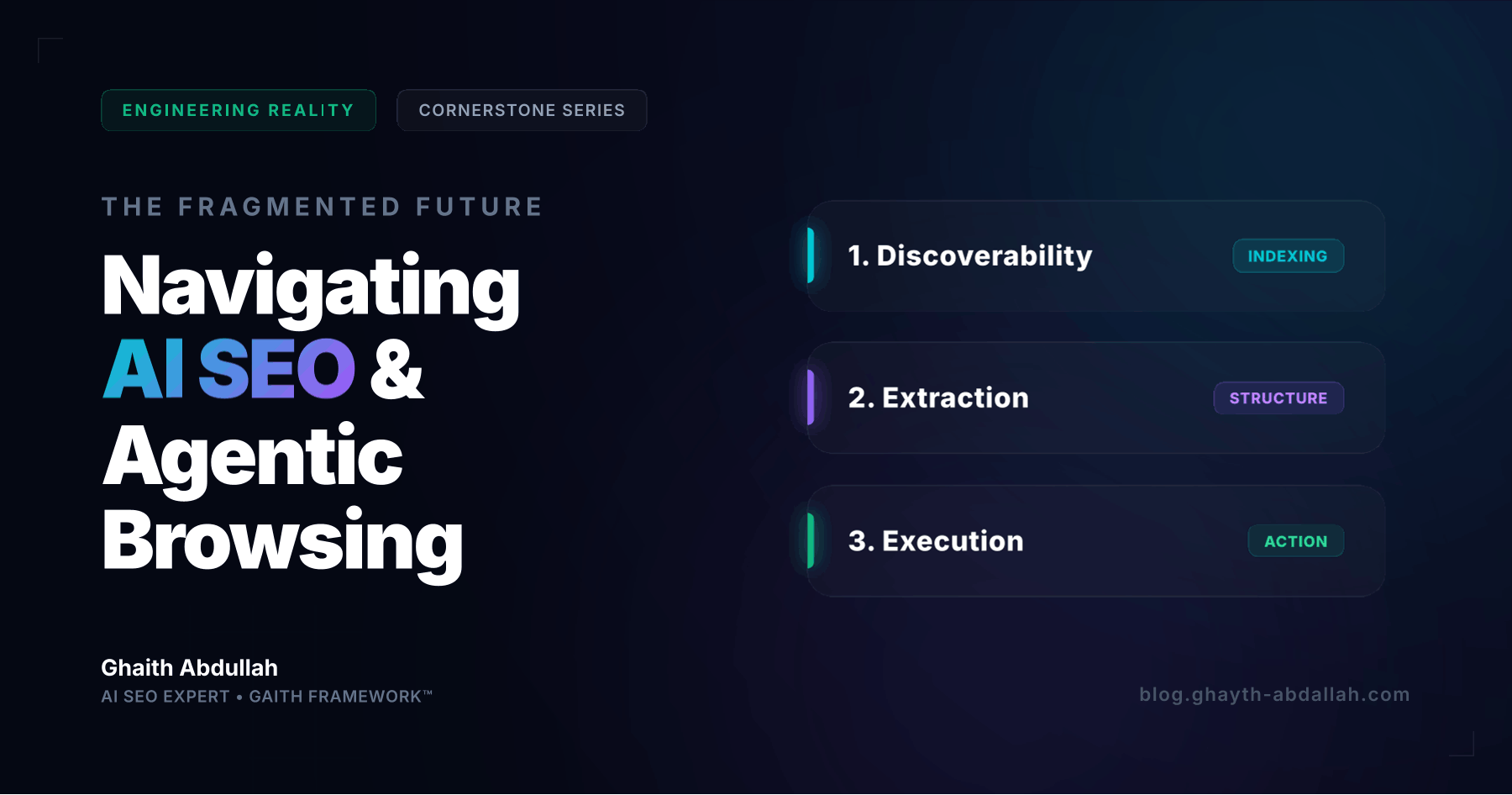
Author's Note: The search ecosystem is undergoing significant shifts, but the industry is currently flooded with "protocol inflation"—taking real engineering primitives and promoting them into unverified global standards. This article strips away the synthetic certainty to provide a high-level strategic analysis of how AI search, retrieval systems, and experimental agentic browsing are actually evolving based on observable retrieval, indexing, and agent behavior patterns across AI systems as of late May 2026 rather than inferred from marketing documentation or vendor claims.
The enterprise client was baffled. Their newly launched platform had excellent technical foundations, a strong backlink profile, and dominant traditional rankings. Yet, when exploring emerging AI search tools and experimental agents, their brand visibility was entirely inconsistent.
They hadn't been penalized. They had simply run into the reality of the modern web: the belief that "AI SEO is a single, unified system" is a myth.
This article expands on our earlier analysis, “The Absolute Truth About SEO, AEO, and GEO” moving beyond foundational AI retrieval mechanics into the fragmented realities of modern agentic search and execution-layer infrastructure.
The modern search ecosystem is structurally fragmented across indexing, retrieval, and agent execution layers, with no unified operational standard across providers. On one side, traditional SEO practitioners continue to prioritize indexing and authority signals within established search frameworks; on the other, emerging “AI optimization” narratives frequently introduce unverified techniques and loosely defined protocols that are not consistently supported by documented system behavior. The reality is that winning in 2026 requires separating the core layers of the modern web: Discoverability, Extraction, and Execution.
1. The Discoverability Layer: The Persistence of Core Signals
Indexing velocity and crawler segmentation
Recent Google core updates appear to continue a long-term trend of devaluing highly synthesizable "commodity content" in favor of robust E-E-A-T. But beyond standard crawlability, discoverability in the AI era is becoming increasingly nuanced.
Accelerated Discovery: Systems like Perplexity rely heavily on rapid web retrieval. Leveraging tools like the Microsoft IndexNow API provides a fast, verified method to push content updates to participating engines, acting as an optimization lever for broader AI visibility.
Crawler Segmentation Trends: It is no longer accurate to view AI bots as a single monolith. While user-agent behaviors vary by provider and are not uniformly documented, some platforms maintain distinct crawling pipelines for model training versus live search retrieval. Navigating these segmentations requires adaptable
robots.txtstrategies to balance proprietary data protection with search visibility.
Retrieval & SEO Behavior (Documented Signals)
Definition: Indexing and crawler visibility depend on publicly documented crawling systems and indexing APIs.
Microsoft IndexNow is a documented API used to notify supported search engines of content updates.
OpenAI uses
GPTBotfor training data collection andOAI-SearchBotfor retrieval-based systems.Anthropic uses
ClaudeBotfor web crawling and model training ingestion.Google uses separate crawlers for indexing and AI training systems (e.g., Googlebot vs Google-Extended).
Perplexity uses its own documented crawler
PerplexityBot) in addition to external index sources.
Important constraint:
Exact weighting of these signals in AI ranking systems is not disclosed in official documentation by providers, and providers do not disclose full ranking formulas or cross-system weighting between indexing and retrieval crawlers.
2. The Extraction Layer: Structuring for Machine Payloads
How AI systems process content and context
Getting retrieved is only the first step. To be cited by AI search products, content must be easily extractable. While RAG implementations are generally observed to perform better with clear heading hierarchies and direct answers, the infrastructure required to serve context is shifting.
The Edge Routing Best Practice: Community proposals like llms.txt are emerging as conventions to provide machine-readable context. Whether serving specialized markdown files or handling aggressive bot crawls, relying solely on an origin database is risky. Utilizing high-performance edge infrastructure (such as Cloudflare or Vercel) to cache and serve these machine payloads is rapidly becoming an operational best practice.
Retrieval & SEO Behavior (Documented Signals)
Definition: Machine-readable context formats are emerging, but not standardized.
/llms.txtis a community-driven convention for providing structured context to AI systems.It is not part of any official standard from major AI providers.
Handling of this file is implementation-specific and not disclosed in official documentation by providers.
Implementation Reality:
Both Google (for AI search) and Anthropic (Claude) officially document that their retrieval pipelines skip or exclude content hidden behind paywalls or mandatory logins.
Un-gated readability is treated as a hard extraction constraint.
Constraint:
There is no verified universal crawler requirement for /llms.txt. How specific models explicitly weight schema versus unstructured text is not disclosed in official documentation by providers.
3. The Execution Layer: The Brutal Physics of the Actionable Web
Latency, rendering, and agentic interoperability
We are transitioning from a web of "discovery" to a web of "action." While an "execution layer" is not a formally standardized web architecture, the conceptual shift toward agentic interoperability is increasingly defined by strict performance heuristics.
The Render Reality: Autonomous agents demand efficiency. Pure Client-Side Rendering (CSR) often creates friction for automated parsers. Architectural shifts toward React Server Components (RSC) and Server-Side Rendering (SSR) are widely considered best practices, as they deliver fully formed HTML, minimizing the risk of JavaScript rendering failures during crawling.
High-Performance Latency: Real-time retrieval-augmented generation (RAG) systems are latency-sensitive in practice, but no official latency thresholds or ranking cutoffs are publicly documented. High-performance edge routing is a strong best practice; excessive server response times may affect inclusion or ranking in latency-sensitive retrieval systems, prioritizing faster, equivalent sources.
MCP-Style Integrations & Commerce Feeds: The ecosystem is exploring ways to expose structured functionality directly to browsers. While formal web-wide execution protocols are still speculative, the trend is clear: discovery relies on markup (like Schema.org), but actual transactional execution relies heavily on structured data feeds (like Google Merchant Center attributes) and emerging integration architectures inspired by the Model Context Protocol (MCP).
Retrieval & SEO Behavior (Documented Signals)
Definition: Execution relies on verified structural and rendering accessibility.
Google Merchant Center product feeds are officially documented as the primary data source for Google's Shopping Graph.
Model Context Protocol (MCP) is an open standard introduced by Anthropic for connecting AI systems to external tools and data sources.
Implementation Reality:
React Server Components improve server-side rendering reliability.
Server-side rendering improves crawler accessibility.
Client-side rendering increases parsing dependency on JavaScript execution.
Constraint:
Specific latency drop-off thresholds for AI-specific crawlers are not disclosed in official documentation by providers.
MCP is not disclosed in official documentation by providers as a standardized web protocol for general browser-agent execution.
4. The Governance Layer: Surviving Ecosystem Fragmentation
Navigating platform-specific strategies
The final challenge is ecosystem fragmentation. Different platforms have varying approaches to privacy, data sharing, and agent access.
For example, while the Chrome ecosystem pushes toward open, agentic web compatibilities, Apple's environment heavily utilizes its proprietary App Intents framework to connect services with Siri. This emphasizes controlled, platform-specific execution rather than open web scraping. Similarly, privacy-focused browsers implement strict anti-tracking measures that impact how third-party agents interact with content.
To maintain visibility across all devices, brands must recognize that optimization requires navigating both emerging open web patterns and platform-specific privacy architectures.
Retrieval & SEO Behavior (Documented Signals)
Definition: Platform ecosystems dictate execution permissions differently.
Apple App Intents is an OS-level automation framework for exposing app actions to Siri and Apple Intelligence.
Different platforms implement separate privacy and execution models.
Constraint:
Browser-level agent standards are not unified across ecosystems. The specific impact of App Intents on traditional web-based SEO visibility is not disclosed in official Apple documentation.
5. Integrating the G.A.I.T.H Framework™
A conceptual model for navigating technical complexity
Navigating this highly fragmented, rapidly evolving ecosystem requires a structured methodology. The G.A.I.T.H Framework™ acts as a strategic compass for these distinct layers, contextualized for the unique market dynamics of the MENA region.
Generative Intelligence (G): Analyzing emerging Query Fan-Out patterns to ensure content addresses the multifaceted queries generated by users.
Analytics Integration (A): Monitoring identifiable AI retrieval traffic and shifting engagement patterns across diverse platforms.
Intent Mapping (I): Structuring content to satisfy dual-language (Arabic/English) needs and the preferred extraction patterns of AI parsers.
Technical Precision (T): Prioritizing ultra-low latency edge infrastructure, semantic SSR/RSC architectures, and robust product feeds to support reliable machine interactions.
Human Psychology (H): Ensuring that amidst all technical optimizations, the content retains the authentic voice necessary to build trust and drive conversions.
Final Verdict
The future of search is not a guessing game of undocumented technical hacks, nor is it governed by a single, secret global protocol. Winning in this landscape means adopting an elite, technical strategy: deploying high-performance edge infrastructure, structuring content for probabilistic extraction, and understanding the fragmented governance of the agentic web.
Frequently Asked Questions (FAQ)
What is AI SEO in 2026?
AI SEO in 2026 is the practice of optimizing content for both search engine discovery and machine-level extraction and synthesis. It focuses on technical accessibility (rendering, latency), semantic structure, and managing crawler segmentation across different AI platforms.
Is "AI SEO" a single unified system across platforms?
No. AI SEO is highly fragmented. Different platforms utilize different crawlers (e.g., Google-Extended, OpenAI's OAI-SearchBot, PerplexityBot) and operate on different retrieval pipelines. There is no single universal protocol that guarantees visibility across all AI systems.
What is the difference between SEO, AEO, and GEO?
SEO (Search Engine Optimization) optimizes for traditional indexing and human discoverability. AEO (Answer Engine Optimization) focuses on providing direct, factual answers for systems like voice assistants or AI chat. GEO (Generative Engine Optimization) encompasses structuring content specifically for Large Language Models to extract and synthesize into generated responses.
What is the "Extraction Layer" in AI SEO?
The Extraction Layer is the structural phase where an AI system parses and pulls context from a retrieved page. Optimization at this layer involves clear heading hierarchies, semantic HTML, and removing friction like client-side rendering dependencies or paywalls that block automated parsers.
Does adding structured data (Schema.org) help AI visibility?
Yes, structured data aids in the discovery phase by clearly defining content entities. However, specific internal weighting of Schema markup versus unstructured text by models like Claude or Gemini is not disclosed in official documentation by providers.
What is /llms.txt and is it a standard?
The /llms.txt convention is an emerging, community-driven proposal for standardizing markdown context for AI models. While independent AI crawlers may actively ingest these files, it is not an officially adopted standard formally integrated into the retrieval pipelines of Google, Anthropic, or OpenAI.
What is the Execution Layer in AI SEO?
The Execution Layer refers to the conceptual shift from content discovery to transactional interoperability. It encompasses how agentic systems interface with structured product feeds (like Google Merchant Center) or emerging tool contracts to execute actions (like purchases or bookings) on behalf of users.
Do AI systems prefer SSR or client-side rendering?
Server-Side Rendering (SSR) and React Server Components (RSC) are widely considered best practices. They deliver fully formed HTML immediately, reducing latency and minimizing the risk of JavaScript rendering failures that frequently occur when automated parsers encounter pure Client-Side Rendering (CSR).
Is MCP (Model Context Protocol) used in SEO?
The Model Context Protocol (MCP) is an officially released standard by Anthropic for connecting AI models to specific data sources. While it inspires integration architectures, it is not currently documented as a standardized web protocol for general browser-agent execution or as an SEO ranking signal.
What is the biggest factor in AI visibility today?
Technical accessibility combined with authoritative, structured content and strong E-E-A-T signals. The primary factor is ensuring fast crawlability, clean rendering, and strong E-E-A-T signals so AI systems can reliably retrieve and interpret content.
Found this valuable?
Let me know—drop your name and a quick message.

Written by
Ghaith Abdullah
AI SEO Expert and Search Intelligence Authority in the Middle East. Creator of the GAITH Framework™ and founder of Analytics by Ghaith. Specializing in AI-driven search optimization, Answer Engine Optimization, and entity-based SEO strategies.