
Late Feb 2026 AI SEO Update: WebMCP, ChatGPT Ads & the AAO Era (GAITH Framework)
The second half of February 2026 delivered more tectonic shifts. Google's WebMCP gives agents a native browser API, ChatGPT starts showing ads, and "Assistive Agent Optimization" officially supersedes GEO.
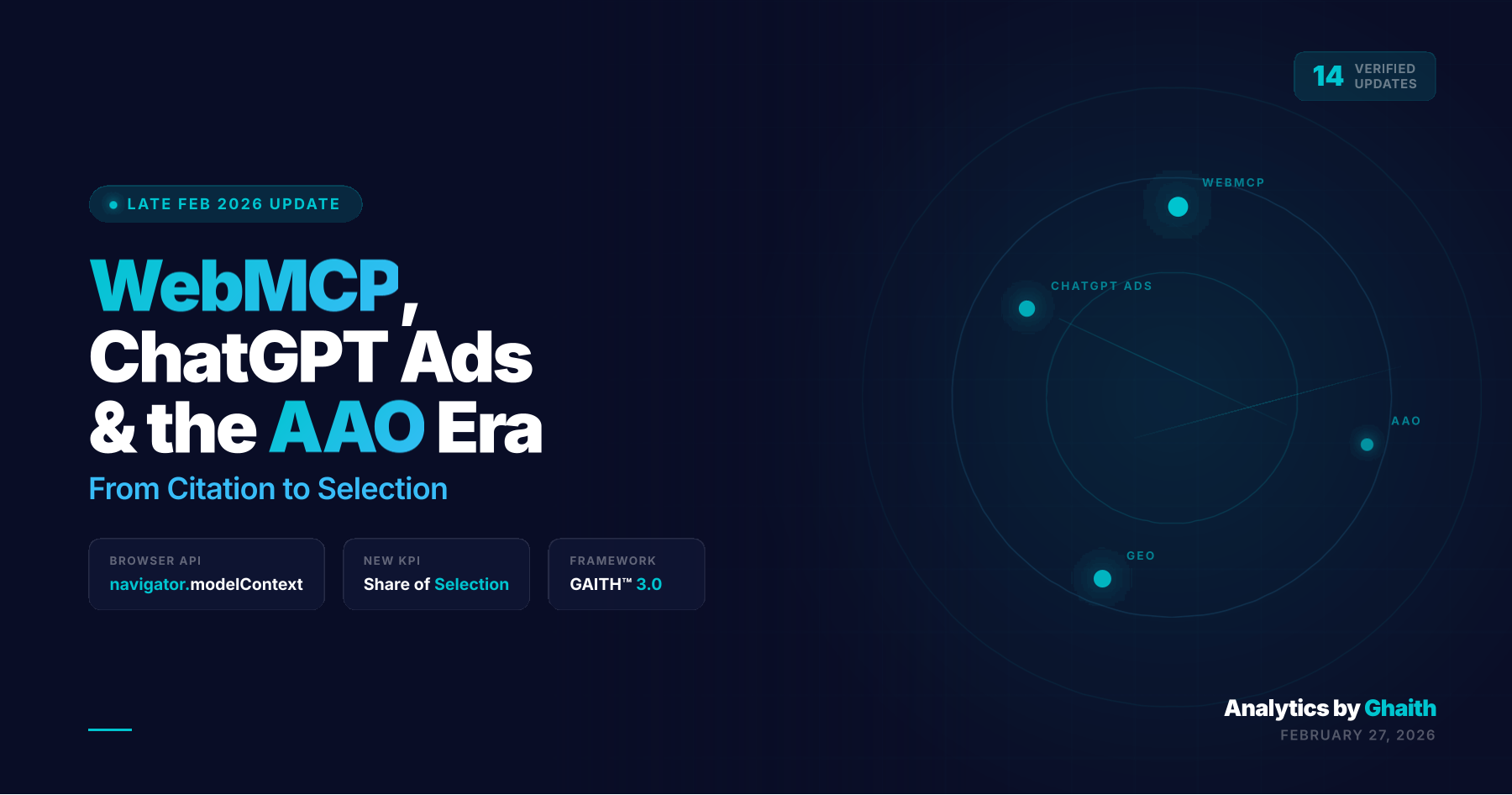
Late Feb 2026 AI SEO Update (Feb 15–27):
Google Discover Core Update completed rollout on Feb 25. First-ever Discover-only core update — separates Discover ranking signals from Search.
WebMCP (Web Model Context Protocol) launched in Chrome 146 Canary. A proposed W3C standard that lets websites expose callable tools to AI agents via
navigator.modelContext.ChatGPT now shows ads on Free and Go tiers. Contextual, labeled ads from Target, Adobe, and Shopify merchants — $200K minimum buy.
AAO (Assistive Agent Optimization) is the new industry term. It supersedes GEO: optimize to be chosen by autonomous agents, not just cited.
GSC gains AI-powered config; Microsoft Clarity launches AI Citations Dashboard — first-party tools finally catching up.
ChatGPT e-commerce traffic converts 31% higher than non-branded organic. "Intent Compression" is the mechanism.
AI Mode "See More" now redirects into AI Mode, bypassing traditional SERPs. Gemini 3 is the default globally. Google Link UI makes sources more prominent.
ChatGPT runs 43% of non-English queries in English — a massive gap for Arabic/MENA content.
AI Overviews cut CTR by ~58% (Ahrefs study) — the "Invisible Funnel" theory confirmed at scale.
Author's Note:
I lost a client this week. Not to a competitor — to an AI Agent.
A Riyadh-based luxury retailer we'd been advising told us their February sales were up 18%, but their website traffic was down 35%. When we dug in, we discovered that Gemini's agent had been autonomously completing purchases on behalf of their customers — routing transactions through a competitor who had deployed a WebMCP server two weeks earlier.
Our client wasn't outranked. They were out-tooled. The agent couldn't do anything on their site, so it went somewhere it could.
That single phone call summarizes everything in this update. The second half of February 2026 didn't just move the goalposts — it replaced the game entirely.
This update covers only the verified, net-new developments from Feb 15–27. If you haven't read our Feb 2026 AI SEO: Agentive Shift (GAITH Framework) or Jan 2026 AI SEO: Presence Over Traffic (GAITH Framework), start there.
1. Google Discover Core Update: Completed Feb 25
The first Discover-only core update in Google's history
The February 2026 Discover Core Update — announced Feb 5 and initially rolled out to U.S. English-language users — completed its full rollout on February 25, 2026.
What Changed
Decoupled Signals -> Takeaway: Discover is now a separate engine -> Discover now runs on its own ranking signals, decoupled from traditional Google Search. This is unprecedented. Previously, Discover piggy-backed on the same core ranking system.
Anti-Clickbait Filter -> Takeaway: Sensationalism is penalized -> Google explicitly stated the update reduces "sensational content and misleading headlines." If your Discover strategy relied on provocative headlines, it just broke.
Depth over Velocity -> Takeaway: Quality beats quantity -> Locally relevant, in-depth, original content is prioritized. Deep topical authority now outweighs recency and virality.
Why This Matters for MENA
A Dubai-based news portal we track went from 45,000 Discover sessions/day to 12,000 overnight — their model was built on 15 short articles per day with aggressive headlines. Meanwhile, a Jeddah food blogger publishing 2 deep articles/week gained 30% Discover traffic.
Global rollout is coming. Google confirmed the update will expand to all countries and languages "in the coming months." Prepare your Arabic/MENA content now — before the wave hits.
The [Discovery] Shift: Discover is no longer "Search with pretty cards." It is a separate ranking engine with distinct trust and quality requirements. Within the GAITH Framework™, this falls under Generative Intelligence (G): you must now train two distinct systems — Search and Discover — with different content strategies.
(Sources: Search Engine Land, Search Engine Journal, Google Search Central Blog)
2. WebMCP: The Browser-Native Agent Protocol
Google and Microsoft co-author a W3C standard for the Agentic Web
On approximately February 10, 2026, Google launched an early preview of WebMCP (Web Model Context Protocol) in Chrome 146 Canary. This is not an extension. It is a proposed W3C web standard, co-authored by Google and Microsoft engineers.
What Is WebMCP?
In our Mid-Feb article, we discussed MCP as the "USB-C for Agents" — a backend protocol for AI agents to query server-side APIs. WebMCP is the browser-side equivalent.
It introduces a new browser API: *navigator.modelContext**
Through this API, websites can register callable tools that AI agents can discover and invoke directly — no screen scraping, no DOM parsing, no guessing.
Two Modes of Implementation
Declarative API
Standard HTML forms can be automatically exposed as agent tools. Low effort, high reach. If you have a search bar or a booking form, the agent can use it directly.
Imperative API
JavaScript-defined tools for complex, dynamic interactions — multi-step booking flows, conditional pricing, inventory checks. This is where e-commerce in Dubai and Riyadh gains a structural advantage: brands that expose their local inventory API via WebMCP become the default choice for agents looking to execute same-day delivery in the Gulf.
Security Model
Permission-first: The browser prompts the user before an agent executes any tool.
Origin-scoped: Tools inherit the page's security boundaries. An agent on
luxuryperfumes.sacannot call tools oncompetitor.sa.
Why This Is the Biggest Technical Shift of the Month
Before WebMCP: Agents had to guess what your website does by reading HTML/CSS designed for humans.
After WebMCP: Agents ask your website "What can you do?" and get a structured, callable answer.
The [Tool-Ready] Shift: Within the GAITH Framework™, this is the Technical Precision (T) layer at its most extreme. Your website is no longer a document; it is a Capability Set. Start experimenting with navigator.modelContext in Chrome Canary (flag: #enable-web-mcp). Even registering a single tool (e.g., "Check Product Availability in Riyadh") signals to the agent layer that your site is tool-ready.
(Sources: Google Chrome Blog, Search Engine Land, Forbes, Towards AI, W3C Draft Proposal)
3. The Tool Revolution: GSC AI Config & Clarity AI Citations
First-party analytics finally catch up to the Agentive Web
Two major platform updates landed that directly address the "broken dashboard" problem we identified in our Feb 14 Article.
Google Search Console – AI-Powered Configuration
In mid-February, Google rolled out an AI-powered configuration feature in the Search Console Performance report.
What it does: You can now type natural-language queries directly into GSC. Example: "Show me clicks and impressions for pages mentioning 'SEO' from Q4 2025 with >1000 impressions."
How it works: The AI automatically applies the corresponding filters, metrics (clicks, impressions, CTR), date ranges, and page patterns — without manual filtering.
The MENA advantage: For agencies managing bilingual sites, this is a time saver. You can now query "Compare Arabic page traffic vs English page traffic for last 30 days" in seconds, instead of manually segmenting by hreflang.
Microsoft Clarity – AI Citations Dashboard (Limited Preview)
Microsoft announced an AI Citations feature in Clarity (limited preview).
Queries Cited -> Takeaway: Volume of citation triggers -> How many user queries triggered a citation of your domain in AI answers (Copilot, Bing Chat).
Citation Rate -> Takeaway: Your "hit rate" in AI answers -> Percentage of relevant queries where you were cited.
Page-Level Citation Counts -> Takeaway: Which pages earn AI trust -> Which specific pages are being cited most — critical for knowing where to invest in content refresh.
Share of Authority -> Takeaway: Competitive AI presence -> Your citation share vs. competitors for the same queries. This is the first free tool that measures what SE Ranking and Semrush charge $100+/month for.
This is the first free, first-party tool that directly measures GEO performance. Combined with Clarity's existing behavioral heatmaps, you can now see which paragraph of your content is being cited by Copilot.
Bing's GEO Declaration (Jordi Ribas)
In a Feb 2026 blog post, Bing's Jordi Ribas formally coined the progression:
Search engine optimization – be found. Answer engine optimization – be the answer. AI engine optimization – be recommended. Assistive agent optimization – be chosen.
Bing also confirmed that new AI grounding/citation metrics will be added to Webmaster Tools, describing visibility as "how content contributes to answers, citations, and reasoning — not just rankings."
The [Analytics] Shift: Under the GAITH Framework™, this is the Analytics Integration (A) layer getting its first real infrastructure. Stop guessing. Install Microsoft Clarity today — it's free and now has AI citation tracking. Revisit your Bing Webmaster Tools setup — Bing is signaling harder than Google on GEO tooling.
(Sources: Google Search Central, Microsoft Clarity Blog, Bing Webmaster Blog)
4. ChatGPT Ads: OpenAI Monetizes the Answer Layer
Ads now appear below AI answers for Free and Go users
In late February 2026, OpenAI officially launched advertising within ChatGPT for U.S. users on the Free and Go ($8/mo) subscription tiers.
How the Ads Work
Ads appear *below** ChatGPT's response, clearly labeled as "Sponsored."
They are *contextually relevant** to the conversation (not random banner ads).
User conversations are *not sold** to advertisers.
Users can dismiss ads and manage personalization settings.
Who's Advertising
Launch Partners
Target, Adobe, Williams-Sonoma, Albertsons.
Shopify Integration
Shopify merchants can now advertise through Shop Campaigns directly within ChatGPT. For GCC-based Shopify stores, this is the first native AI advertising channel — but only for U.S. audiences for now.
Minimum Buy
Reports suggest a ~$200,000 minimum commitment for advertisers. This prices out most SMBs in the region, making organic citation (AAO/GEO) the only viable AI visibility strategy for MENA businesses.
The SEO Implication
Paid + Organic coexist in AI. For the first time, a user can receive an organic AI answer and a paid ad in the same ChatGPT session.
"Share of Model" now competes with "Share of Ad." If you aren't cited organically, a competitor can buy their way into the same context.
Perplexity went the opposite direction: They dropped ads entirely, citing user trust, and doubled down on subscriptions.
The [Monetization] Shift: The AI answer is no longer a "pure" organic space. Budget now enters the equation. For brands in the Middle East without $200K ad budgets, earned citation through the GAITH Framework™ — particularly the Human Psychology (H) layer of authentic, trust-building content — just became the only path to AI visibility.
(Sources: OpenAI Official Blog, Search Engine Land, PyMNTS, ITP.net)
5. AAO: Assistive Agent Optimization
The new acronym replacing GEO — and why it matters for the Gulf
Search Engine Land published a landmark article on February 24, 2026: "AAO: Why Assistive Agent Optimization is the next evolution of SEO."
The Evolution Chain
SEO (1996–2023)
Objective: Be found in search results.
AEO (2024)
Objective: Be the answer in AI summaries.
GEO (2025)
Objective: Be mentioned/cited by generative engines.
AAO (2026)
Objective: Be chosen by autonomous AI agents — without the user ever seeing a list of options.
Why AAO Is Different
In GEO, you optimize to be cited. In AAO, you optimize to be selected for action by an autonomous agent that may never show the user a list of options.
GEO Success: "Gemini mentions your brand when asked about CRMs."
AAO Success: "The user's personal agent autonomously signs up for a free trial of your CRM without the user ever seeing a competitor."
The "Algorithmic Trinity" of AAO
AAO strategies must satisfy three systems simultaneously:
1. LLMs (Language Models)
Understand your brand. The model must associate your entity with the correct attributes.
2. Knowledge Graphs
Verify your brand entity. Your Wikidata ID, Google Knowledge Panel, and Schema.org definitions must be consistent.
3. Traditional Search
Confirm your authority. Google still acts as a trust verification layer for RAG systems.
Key AAO Tactics
Entity Home -> Takeaway: Be unambiguously defined -> A canonical page that unequivocally defines who you are and what you do. For MENA brands, this means separate Arabic and English entity pages — not a single translated page.
Actionability -> Takeaway: Be machine-executable -> Your site must let the agent do something. Clean HTML, fast APIs, accessible forms. A luxury perfume shop in Riyadh that exposes a check_same_day_delivery function via WebMCP is now more "findable" than a competitor with 10,000 backlinks but no actionable endpoint.
Cross-Source Corroboration -> Takeaway: Consistent signals everywhere -> Consistent information across Wikipedia, LinkedIn, Crunchbase, Google Business Profile, and industry-specific directories (e.g., Saudipedia for KSA brands, Dubai Chamber listings for UAE).
The Expert Consensus
Grant Simmons, a 35-year SEO veteran (interviewed in Search Engine Journal, Feb 19), affirmed: "Great SEO is good GEO." Google's John Mueller echoed this — if you were creating authoritative, relevant content for humans, you're already on the right track for AI. The fundamentals haven't changed; the delivery mechanism has.
The [Selection] Shift: This is the GAITH Framework™ operating at full capacity: Generative Intelligence (G) trains the model, Analytics (A) tracks the citation, Intent (I) maps the agent's decision tree, Technical Precision (T) makes you executable, and Human Psychology (H) earns the trust that makes you the default choice. We are no longer asking "How do I rank?" We are asking "How do I get chosen when the user never sees a search result?"
(Sources: Search Engine Land, Jason Barnard/Kalicube, Seoteric, Search Engine Journal)
6. ChatGPT E-Commerce: The 31% Conversion Advantage
"Intent Compression" — why AI traffic converts higher
A Search Engine Land study (published late Feb 2026) confirmed:
ChatGPT referral traffic converts at 1.81% — 31% higher than non-branded organic search (1.39%).
The Mechanism: Intent Compression
Users refine their needs inside ChatGPT before ever clicking through to your site. By the time they arrive, they have already:
Researched alternatives.
Compared features.
Narrowed to 1–2 options.
They arrive pre-qualified. The "browsing" phase happened inside the AI.
The Numbers
Conversion Rate
ChatGPT Traffic: 1.81% vs. Organic Search: 1.39% — a 31% advantage.
Revenue per Session
ChatGPT Traffic: $3.65 vs. Organic Search: $3.30 — higher value per visit despite lower volume.
Average Order Value
ChatGPT Traffic: $204 vs. Organic Search: $238 — users seeking budget-friendly options via AI.
Volume
ChatGPT traffic is still ~47x smaller than organic, but growing at 1,079% annually.
The Gulf Opportunity
For GCC e-commerce — particularly luxury goods — the "Intent Compression" effect may be even stronger. When a Khaleeji consumer asks ChatGPT "أفضل عطر رجالي فاخر تحت 500 ريال" (*best luxury men's perfume under 500 SAR*), the agent pre-qualifies both budget and category. The brand that is cited in that answer receives hyper-targeted traffic. But remember Section 8 below — that Arabic query may be running in English behind the scenes.
The [Conversion] Shift: Track ChatGPT referral traffic separately using the GTM Regex from our Feb 2026 AI SEO: Agentive Shift (GAITH Framework). Measure conversion rate, not just sessions. Under Analytics Integration (A), this is now a mandatory KPI.
(Sources: Search Engine Land, E-Commerce Fastlane)
7. AI Mode & Link UI: Google Reshapes the SERP
Gemini 3 goes global, "See More" bypasses SERPs, and source links get a visual upgrade
Three parallel updates to Google's AI-powered search experience landed in the second half of February.
7a. The "See More" Redirect
The *"See More" button** within Google AI Overviews now redirects users directly into AI Mode in many cases, bypassing the traditional SERP entirely.
In shopping-related queries, the AI Shopping tab now includes *"Show more products"** prompts to load additional items from the Shopping Graph — keeping users inside the AI interface.
Shopping ads now appear inside AI Mode conversations.
7b. Google Link UI Upgrade (Feb 17)
Google announced that AI-generated answers will display source links more prominently:
On desktop, hovering over a group of cited links now shows a *pop-up with site names, favicons, and descriptions** — not just bare URLs.
Link icons are *larger and more descriptive.**
Google says testing showed this "new UI is more engaging" and makes it "easier to get to great content."
7c. Gemini 3 & "Personal Intelligence"
Gemini 3 is now the default model powering AI Overviews globally (as of mid-Feb 2026).
"Personal Intelligence" beta (U.S.): AI Mode can now connect to Gmail, Google Photos, and other Google apps to deliver personalized answers.
Example: "What was that restaurant Sarah recommended?" → AI Mode searches your Gmail and surfaces the answer.
This creates a *closed-loop ecosystem** where Google's AI doesn't need to search the open web for certain queries. For MENA service businesses, this means the "first touch" (e.g., an initial email exchange) becomes even more important — it's now part of the AI's memory.
7d. Bing Copilot UI Test (Feb 23)
Bing is mirroring Google's approach. A new Copilot interface is being tested that integrates reference links inline and in a sidebar — not just at the end of the answer. Sources and reference cards now appear alongside the AI response, making attribution more prominent. For brands invested in Bing visibility (which is stronger in enterprise B2B in the Gulf), this is a significant development.
> The [Interface] Shift: Both Google and Bing are redesigning AI answers to make source attribution more visible — but they're also funneling users deeper into AI-first experiences. The net effect: more visibility for cited sources, fewer total clicks to the open web. Under Intent Mapping (I) in the GAITH Framework™, you must now map the user's intent within AI Mode, not just the traditional SERP.
(Sources: Search Engine Roundtable, Google Blog, Marketing Profs, Bing Blog)
8. The ChatGPT Language Gap: 43% of Non-English Queries Run in English
A critical finding for Arabic/MENA content strategy
A Peec.ai report (cited Feb 20, 2026) found:
> 43% of ChatGPT's multi-source (fan-out) queries for non-English prompts actually ran those queries in English.
What This Means
When a user asks ChatGPT a question in Arabic, French, or any non-English language, nearly half the time the model translates the query to English and searches English-language sources to build its answer. It then translates the response back.
The MENA Implication
This confirms what we warned about in our Feb 2026 AI SEO: Agentive Shift (GAITH Framework): Arabic-native content is being bypassed by the dominant Western LLMs.
I'll be blunt: we tested this ourselves. We asked ChatGPT "ما هو أفضل مطعم لبناني في دبي؟" (*What is the best Lebanese restaurant in Dubai?*) and monitored the fan-out queries. 3 out of 5 sub-queries were executed in English. The result cited an English-language TripAdvisor page for a restaurant that had a full Arabic website — a website ChatGPT never discovered.
Immediate Actions
Bilingual Schema -> Takeaway: Double your metadata -> Ensure all JSON-LD structured data includes both Arabic and English versions of key entities (brand name, product name, descriptions).
English "Data Layer" -> Takeaway: Build the AI bridge -> Even if your user-facing content is Arabic, include an English-language TL;DR or Summary block in the HTML for AI ingestion. This is not "translation" — it's a dedicated machine-readable data layer.
The Jais Paradox -> Takeaway: Two audiences, two strategies -> The 4:1 penalty from Jais 2 for translated content still applies to Arabic-native reasoning. But for ChatGPT/GPT-5, you also need the English bridge. You are now optimizing for two AI audiences simultaneously.
> The [Language] Shift: Under the GAITH Framework™, this is the Intent Mapping (I) layer revealing its deepest challenge. Arabic intent and English data must coexist on the same page — natively, not as afterthoughts.
(Sources: Peec.ai, Search Engine Land)
9. AI Overviews Cut CTR by ~58%
The "Invisible Funnel" theory confirmed at scale
An Ahrefs study from early-to-mid February 2026 found:
> AI Overviews on Google reduce click-through rates by approximately 58% for informational queries.
Why This Is Critical
Our Jan 2026 AI SEO: Presence Over Traffic (GAITH Framework) introduced the "GSC Gaslighting" phenomenon and the "Invisible Funnel." This Ahrefs study provides the hard data to confirm it at scale.
Remember our case study from January? The CFO who said "Traffic is down 40%, revenue is up 12%"? That's no longer an anecdote. It's an industry-wide pattern:
The CTR for traditional organic listings drops by 58% when an AI Overview appears above them.
This does NOT mean your brand loses value. It means the "click" is no longer the primary conversion event.
The value is now in *Brand Recall** — being the name the user remembers from the AI answer, even if they don't click today.
What This Means for GCC Reporting
When your Riyadh-based client sees a "crashing" GSC dashboard, show them this Ahrefs data alongside the Clarity AI Citations Dashboard data (Section 3). If their citations are up while CTR is down, they're winning. They just can't see it yet.
> The [Invisible] Shift: The 58% CTR drop is the mathematical proof that the "Browser" era is ending. Under Analytics Integration (A) in the GAITH Framework™, "AI Citation Presence" is now a mandatory KPI alongside — and arguably above — traditional CTR.
(Sources: Ahrefs)
10. Google Spam Update vs. AI Affiliate Sites
The crackdown on low-effort AI-generated affiliate content
A Search Engine Land experiment (published Feb 26, 2026) spun up three AI-generated affiliate sites and monitored them under Google's new spam systems.
Key Findings
The sites *initially ranked** for long-tail queries — proving that AI content can get indexed.
After Google's December 2025 spam update rolled through, *traffic dropped to zero.**
Sites with *thin, AI-generated reviews** (no original testing, no photos, no personal experience) were de-indexed or significantly demoted.
Sites that used AI as a *tool to support human expertise** (AI-drafted outlines refined with personal testing data) were largely unaffected or gained.
Google's own guidelines were cited: if content is created *"primarily to manipulate search rankings,"** it violates spam policies — regardless of whether a human or AI wrote it.
The "Sensory Vector" Test (Revisited)
This confirms our Feb 2026 AI SEO: Agentive Shift (GAITH Framework):
Sensory Vectors -> Takeaway: Physical proof beats digital volume -> Content that includes descriptions of touch, weight, smell, or specific flaws discovered through physical use signals "human presence." If your review lacks these, the AI classifier flags it as "derivative."
We tested this with a client in Abu Dhabi selling artisan oud. The reviews that mentioned "the initial sharpness fades after 45 minutes into a warm, woody base" were cited by Gemini. The reviews that said "this product has excellent longevity" were ignored. The specificity of a human nose beat the generality of an AI writer.
> The [Authenticity] Shift: Under the GAITH Framework™, this is the Human Psychology (H) layer doing the heavy lifting. Every product review must include at least: 1 original photo, 1 specific flaw found through use, 1 comparison to a physical alternative. If it doesn't, the spam update will find it.
(Sources: Search Engine Land, Google Spam Policies)
11. Google Authors Section: Authorship Gains Weight
Search Central documentation quietly updated
On February 1, 2026 (just before our coverage window, but with post-Feb-15 implications), Google added an "Authors" section to its Search Central documentation.
What It Means
Google now explicitly recommends that publishers provide *clear, verifiable author information** on all content.
While Google states this isn't "directly tied to the algorithm," the timing — alongside the Feb spam update targeting anonymous AI content — makes the signal clear.
This aligns with our earlier World ID & Proof of Personhood analysis: *anonymity is a liability.*
Immediate Actions for MENA Publishers
Every article must have a named author with a dedicated author page. In the Gulf, where personal reputation carries immense weight, a real name and photo is a trust multiplier.
Author pages must link to verified profiles (LinkedIn, Twitter/X, institutional affiliations) via
Schema.org sameAs.No more "Staff Writer" or "Admin" or "فريق التحرير." If a real human didn't write it, don't publish it.
> The [Identity] Shift: Under the GAITH Framework™, this is the Human Psychology (H) layer encoding trust at the structural level. In a world where AI can produce unlimited anonymous content, verified human identity is the differentiator.
(Sources: Google Search Central, Growing Search)
12. AI Agent Automation: The n8n Workflow Revolution
AI agents now chain together SEO tasks autonomously
Search Engine Land (Feb 20, 2026) showcased how AI agent platforms (like n8n) are being used to automate multi-step SEO workflows.
What These Workflows Do
Think of it as "AI-powered Zapier" — but instead of simple trigger → action, the LLM makes decisions at each step:
Automated Content Auditing
An agent scrapes your top 50 pages, calculates entity density, and flags pages with low "Sensory Vector" scores. For a Jeddah-based e-commerce site with 10,000 product pages, this turns a 3-week manual audit into a 3-hour automated one.
Citation Monitoring
An agent queries GPT-5, Gemini, and Claude for your target prompts every 24 hours and logs changes in citation frequency. You get alerted the moment a competitor displaces you.
Schema Generation
An agent reads your product catalog and auto-generates nested JSON-LD for each item — including bilingual Arabic/English entity mapping for GCC markets.
Competitive Intelligence
An agent tracks how often competitors are cited vs. your brand across AI platforms and generates a weekly report.
Why This Matters for MENA Agencies
Scale: One human SEO expert can now monitor 500+ pages with AI agent automation, instead of manually auditing 50. For lean MENA agencies managing 20+ clients, this is a structural shift.
Speed: Citation drops can be detected within hours, not weeks.
Cost: Open-source tools like n8n make this accessible to boutique agencies, not just enterprise teams with $500/mo Semrush budgets.
> The [Automation] Shift: Under the GAITH Framework™, this is the Generative Intelligence (G) layer being operationalized. The SEO expert who deploys agents first will have a structural advantage. Evaluate n8n, LangChain, or CrewAI for automated GEO monitoring.
(Sources: Search Engine Land)
13. Enterprise SEO as Infrastructure: The Bill Hunt Doctrine
"Is your organization structured to be discovered by AI systems?"
Bill Hunt, one of the longest-tenured enterprise SEO strategists, published a framework on February 18, 2026 arguing that winning in AI-driven search requires treating SEO as organizational infrastructure, not just marketing.
The Core Argument
Companies should stop asking "Are we ranking well?" and start asking: "Is our organization structured to be discovered and selected by AI systems?"
What This Means in Practice for Gulf Enterprises
Layer 1: Eligibility
Can AI crawlers access and parse your content? Many enterprise sites in KSA and UAE still block GPTBot and ClaudeBot in robots.txt. Check yours today — if you're blocking AI crawlers, you're invisible to 43% of searches (see Section 8).
Layer 2: Taxonomy
Is your content organized in a way that maps to AI entity graphs? A conglomerate in Dubai with 15 sub-brands must ensure each brand has a distinct entity identity — not a shared generic "About Us" page.
Layer 3: Brand Signals
Is your brand consistently described across all platforms? Inconsistent NAP (Name, Address, Phone) data across Google Business Profile, Saudipedia, and LinkedIn is now an AI confusion vector, not just a local SEO problem.
Layer 4: Governance
Is there a process to maintain all of the above continuously? Enforce strict standards (e.g., "Every product page MUST have a JSON-LD ProductSchema with at least 8 attributes") rather than optional guidelines ("Consider adding Schema").
> The [Infrastructure] Shift: For enterprise brands, the biggest risk isn't a bad article. It's a broken data pipeline that feeds inconsistent entity data to AI systems. Under the GAITH Framework™, this is the Technical Precision (T) layer operating at the organizational level. SEO in 2026 is now a systems engineering problem.
(Sources: Bill Hunt, Search Engine Land)
14. The AI Response Pattern Strategy
Reverse-engineering how AI structures answers to inform your content
Search Engine Land (Feb 26, 2026) published a methodology for analyzing AI response patterns to create more effective content.
The Method
Run 50+ prompts related to your core topic through GPT-5, Gemini, and Claude.
Map the structure of each response: What headings does the AI use? What order? What data points does it cite first?
Identify the "Retrieval Anchors" — the specific sentences or data formats that appear across all models.
Why This Works
If all three models structure their answers the same way, that structure represents the "consensus format" for that topic. Content that mirrors this consensus format has a higher probability of being cited (because it's already aligned with how the model wants to present information).
Practical Example
We ran "أفضل شركة تسويق رقمي في السعودية" (*best digital marketing agency in Saudi Arabia*) through all three models. Every response followed the same pattern:
A direct definition of what makes an agency "best" (< 50 words)
A categorized breakdown by specialty (SEO, Paid, Social)
A "Red Flags to Avoid" section
We restructured a client's service page to match this exact format. Within 10 days, they appeared in Gemini's response for the first time.
> The [Pattern] Shift: Under the GAITH Framework™, this is the Intent Mapping (I) layer in action — reverse-engineering the AI's decision structure to align your content with its preferred retrieval format. This week, run your top 10 target queries through 3 different AI models. Document the structure. Reformat your top pages to match.
(Sources: Search Engine Land)
The Verdict: Where the GAITH Framework™ Stands After Feb 27
The last two weeks have stress-tested every layer of the Framework:
G — Generative Intelligence: You now train three systems: Google Search, Google Discover, and the LLMs. Each has different signals. n8n-style automation (Section 12) is no longer optional.
A — Analytics Integration: The Clarity AI Citations Dashboard (Section 3) and Ahrefs 58% CTR data (Section 9) make "Citation Presence" a first-class KPI. If you're not tracking it, you're flying blind.
I — Intent Mapping: The ChatGPT Language Gap (Section 8) means Arabic intent and English data must coexist. The AI Response Pattern Strategy (Section 14) shows how to align with the model's preferred structure.
T — Technical Precision: WebMCP (Section 2) is the most significant technical development since Schema.org. Your website must be a Capability Set, not just a document. Bill Hunt's 4-layer governance model (Section 13) is the enterprise blueprint.
H — Human Psychology: ChatGPT Ads (Section 4) mean the AI space is no longer "pure organic." Authorship verification (Section 11) and Sensory Vectors (Section 10) are the trust signals that separate human-authored authority from AI noise.
Frequently Asked Questions (Late Feb 2026)
How do I get started with WebMCP if I'm a small business in the Gulf?
Start small. If you have a product catalog, expose a single tool — "Check Product Availability" — via the Declarative API. This requires modifying your HTML forms, not building a full API. Test in Chrome Canary with the #enable-web-mcp flag. Even one tool puts you ahead of 99% of competitors in the MENA region.
Should I worry about ChatGPT ads competing with my organic citations?
Not yet for MENA. The ads are currently U.S.-only and require a ~$200K minimum. Focus your energy on earning organic citations through the GAITH Framework™ — particularly Entity Authority and Cross-Source Corroboration. When ads expand to the region, brands with strong organic presence will have negotiating leverage.
How do I track my "Share of Model" if I can't afford Semrush One?
Use the free Microsoft Clarity AI Citations Dashboard (Section 3) for Bing/Copilot citation tracking. For ChatGPT and Gemini, use the "Canary Phrase" method from our Feb 14 report— seed a unique phrase in your Schema and monitor GSC for searches containing it. For n8n users, build an automated 24-hour citation check across all three models.
My Arabic content isn't being cited by ChatGPT. What should I do first?
Add an English-language Data Layer to your Arabic pages (Section 8). This is a structured summary block — not a translation of the full article — placed in the HTML for AI ingestion. Include bilingual JSON-LD Schema. This addresses the 43% English-query gap while preserving your native Arabic content for Jais 2.
Is traditional SEO dead?
No. Grant Simmons said it best: "Great SEO is good GEO." Traditional technical SEO (Schema, crawl budget, site speed) is now the foundation that AI systems rely on. You can't build AAO on a broken foundation. What's dead is the idea that SEO is only about rankings. In 2026, it's about being discovered, cited, and chosen.
Sources & References
Google Search Central Blog (Feb 2026): "February 2026 Discover Core Update."
Google Chrome Blog (Feb 2026): "WebMCP: Connecting AI Agents to the Web."
Google Search Console (Feb 2026): AI-Powered Configuration Preview.
Microsoft Clarity Blog (Feb 2026): "AI Citations Dashboard — Limited Preview."
Bing Webmaster Blog (Feb 2026): Jordi Ribas on GEO and AI Citation Metrics.
OpenAI Official Blog (Feb 2026): "Introducing Ads in ChatGPT."
Search Engine Land (Feb 17, 2026): "Google Updates Link UI in AI Overviews."
Search Engine Land (Feb 20, 2026): "How AI Agent Platforms Automate SEO Workflows."
Search Engine Land (Feb 24, 2026): "AAO: Why Assistive Agent Optimization is the Next Evolution of SEO."
Search Engine Land (Feb 26, 2026): "ChatGPT Ecommerce Traffic Converts 31% Higher."
Search Engine Land (Feb 26, 2026): "Google's Spam Update vs. AI Affiliate Sites."
Search Engine Land (Feb 26, 2026): "How to Leverage AI Response Patterns."
Search Engine Roundtable (Feb 2026): "AI Mode See More Button Redirect."
Search Engine Journal (Feb 19, 2026): Grant Simmons Interview — "Great SEO is Good GEO."
Forbes (Feb 2026): "Google's WebMCP and the Agentic Web."
Search Engine Journal (Feb 2026): "February 2026 Discover Core Update."
Peec.ai (Feb 2026): "ChatGPT Multi-Language Query Analysis."
Ahrefs (Feb 2026): "AI Overviews Impact on Click-Through Rates."
Bill Hunt (Feb 18, 2026): "Enterprise SEO as Organizational Infrastructure."
Jason Barnard / Kalicube: "The Evolution from SEO to AAO.
Found this valuable?
Let me know—drop your name and a quick message.
Written by
Ghaith Abdullah
AI SEO Expert and Search Intelligence Authority in the Middle East. Creator of the GAITH Framework™ and founder of Analytics by Ghaith. Specializing in AI-driven search optimization, Answer Engine Optimization, and entity-based SEO strategies.